
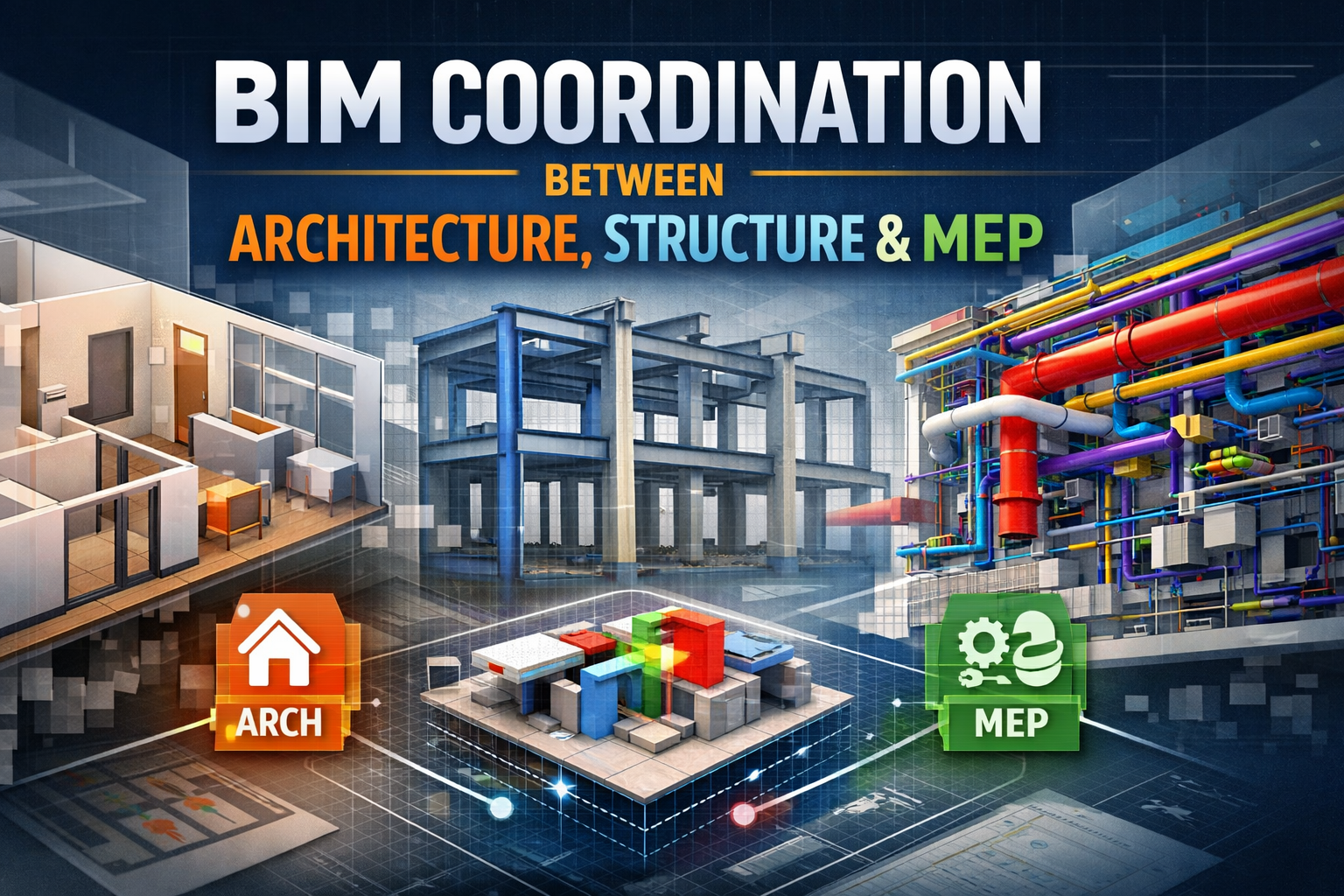
Building Information Modeling (BIM) has transformed the way modern construction projects are planned, designed, and executed. BIM helps in overcoming the challenges of isolated drawings produced by different disciplines. It creates a shared digital environment where architects, structural engineers, and MEP engineers work together on a single intelligent model.
The systematic alignment of architectural, structural, and MEP systems created with the help of BIM coordination ensures that a building functions properly without design conflicts.
Effective BIM coordination helps project teams identify clashes, optimize space utilization, improve construction sequencing, and reduce costly rework during construction.
In today’s world, buildings are a complex project with integrated HVAC systems, electrical networks, plumbing pipelines, and structural components. Coordination across these different disciplines is only possible through BIM.
Understanding BIM Coordination
BIM coordination involves the process of integrating and aligning multiple discipline models. Architectural, structural, and MEP components are merged into a single coordinated model. Each discipline creates its own BIM model based on its design requirements. At last, these models must ultimately work together without physical or functional conflicts.
For example, an architect may design a ceiling space for aesthetic purposes, while an HVAC engineer plans ductwork through the same space. If coordination is not done properly, the duct may intersect with structural beams or lighting fixtures. BIM Coordination identifies such issues early in the design phase through clash detection and model review, allowing teams to resolve conflicts before construction begins.
The result is a coordinated digital model that reflects the real-world integration of all building systems.
Role of Architectural BIM in Coordination
Architectural BIM is the foundation of the coordinated model because it defines the building’s spatial layout, floor plans, walls, doors, windows, ceilings, and other design elements. Architects establish these components that later establish the structural grid and spatial boundaries guiding the work of other disciplines.
During BIM coordination, the architectural model serves as the reference framework. Structural engineers use it to align beams, columns, and slabs with architectural layouts, while MEP engineers use the model to route ducts, pipes, and cable trays through available spaces.
Architectural BIM also plays an important role in maintaining design intent. For example, the placement of ceilings, facade systems, or interior walls must be coordinated with HVAC ducts, plumbing systems, and electrical conduits to avoid visual or spatial conflicts. Through BIM coordination, architects can ensure that mechanical systems do not compromise aesthetics or usable space.
Structural BIM and Its Coordination Requirements
Structural BIM focuses on the building’s load-bearing framework, including foundations, beams, columns, slabs, and reinforcement details. Since structural components are often large and rigid, they significantly influence how other building systems are arranged.
In coordinated BIM models, structural elements must align with architectural layouts while leaving space for mechanical and electrical systems. For example, beam depths must be coordinated with ceiling heights and HVAC duct routes. If structural beams occupy too much space in the ceiling zone, MEP engineers may need to redesign their systems.
Structural BIM coordination also ensures that openings for pipes, ducts, and cable trays are properly planned in slabs and walls. Without this coordination, contractors might need to drill or cut structural elements on site, which can weaken the structure and increase project risks.
MEP BIM and Its Complexity
MEP systems consist of mechanical, electrical, and plumbing. It’s among the most complex components of modern buildings. HVAC ducts, chilled water pipes, drainage systems, fire protection lines, electrical conduits, and cable trays must all be carefully routed through limited building spaces.
MEP BIM coordination ensures that these systems are placed efficiently without interfering with architectural features or structural components. For example, a large air duct may need to pass through a structural beam opening or share space with electrical cable trays in a service corridor.
Because MEP systems often occupy ceiling spaces and service shafts, coordination is crucial to prevent congestion. BIM tools allow engineers to visualize these systems in 3D, making it easier to adjust routing paths, maintain required clearances, and comply with safety codes.
Clash Detection and Conflict Resolution
One of the most powerful advantages of BIM coordination is clash detection. In traditional 2D workflows, design conflicts might only become visible during construction, leading to delays and additional costs. BIM software automatically identifies clashes between different systems in the digital model.
Clashes can occur in several forms:
Hard clashes – physical intersections between components, such as a pipe passing through a beam.
Soft clashes – insufficient clearance between systems, which may affect installation or maintenance.
Workflow clashes – conflicts related to construction sequencing or accessibility.
Once these issues are detected, the project team reviews them in coordination meetings and updates the models accordingly. This proactive process reduces errors and ensures that the final design is constructible.
Benefits of BIM Coordination
When architectural, structural, and MEP models are effectively coordinated, projects benefit in several ways.
First, construction errors are significantly reduced because conflicts are resolved during the design phase. Contractors can follow accurate models without needing last-minute adjustments on site.
Second, project timelines improve. Coordinated BIM models help teams plan installation sequences more efficiently, reducing delays caused by redesign or field modifications.
Third, cost savings increase. Detecting clashes early prevents expensive rework, material waste, and labor overruns.
Finally, project communication becomes more efficient. A coordinated BIM model acts as a shared visual reference for architects, engineers, contractors, and project owners.
Conclusion
BIM coordination between architecture, structure, and MEP is essential for modern construction projects. By integrating these disciplines into a single digital model, BIM allows teams to identify conflicts early, optimize system layouts, and ensure that buildings function as intended.
Architectural BIM provides the spatial framework, structural BIM defines the building’s strength and stability, and MEP BIM integrates complex mechanical and electrical systems. When these elements are coordinated effectively, projects achieve better efficiency, fewer construction issues, and improved overall quality.
With experienced BIM professionals and advanced coordination workflows, companies like Simsona play a key role in making this process seamless. Their BIM coordination services help transform complex building designs into well-integrated, construction-ready models, ensuring smoother project delivery from design to completion.
FAQs
1. What is BIM coordination in construction?
BIM coordination is the process of integrating architectural, structural, and MEP models into a single digital environment to ensure all building systems work together without conflicts. It helps project teams detect clashes, optimize design layouts, and improve collaboration before construction begins.
2. Why is BIM coordination important for construction projects?
BIM coordination is important because it reduces design conflicts, minimizes construction errors, improves project efficiency, and saves costs. By detecting clashes between different building systems early in the design phase, teams can avoid expensive rework during construction.
3. What disciplines are involved in BIM coordination?
BIM coordination typically involves three major disciplines: architecture, structure, and MEP (Mechanical, Electrical, and Plumbing). These disciplines collaborate within a shared BIM model to ensure that all components of the building fit and function properly.
4. What is clash detection in BIM coordination?
Clash detection is a process in BIM where software tools identify conflicts between different building elements. For example, it can detect if a duct intersects with a beam or if electrical conduits clash with plumbing pipes. Resolving these issues early improves construction accuracy.
5. Which software tools are commonly used for BIM coordination?
Common BIM coordination tools include Autodesk Revit, Navisworks, BIM 360, andn Solibri. These platforms allow project teams to combine multiple discipline models, perform clash detection, and collaborate effectively throughout the project lifecycle.
6. How does BIM coordination improve collaboration between project teams?
BIM coordination improves collaboration by providing a shared 3D model where architects, structural engineers, and MEP engineers can review designs together. This shared environment enhances communication and ensures that all stakeholders are working with accurate information.
7. What challenges occur without BIM coordination?
Without BIM coordination, projects often face design conflicts, installation issues, construction delays, and increased costs. Contractors may discover clashes between systems only during construction, leading to rework and schedule disruptions.
8. How does MEP coordination work in BIM?
MEP coordination involves arranging mechanical ducts, electrical systems, plumbing pipes, and fire protection systems within the available building space. Using BIM models, engineers ensure these systems are routed efficiently without interfering with architectural or structural elements.
9. At what stage of a project is BIM coordination performed?
BIM coordination typically begins during the design development phase and continues through construction documentation and pre-construction planning. Early coordination ensures that potential issues are resolved before construction starts.
10. How can Simsona help with BIM coordination services?
Simsona provides professional BIM coordination services that integrate architectural, structural, and MEP models into a fully coordinated digital model. Using advanced BIM tools and experienced professionals, Simsona helps identify clashes, optimize system layouts, and deliver construction-ready BIM models that improve project efficiency.

Send us
drawings and scope
Click the link below and send us your complete scope and drawings. We will provide quote/proposal in 24 to 48 hours.
 301-774-0880
