
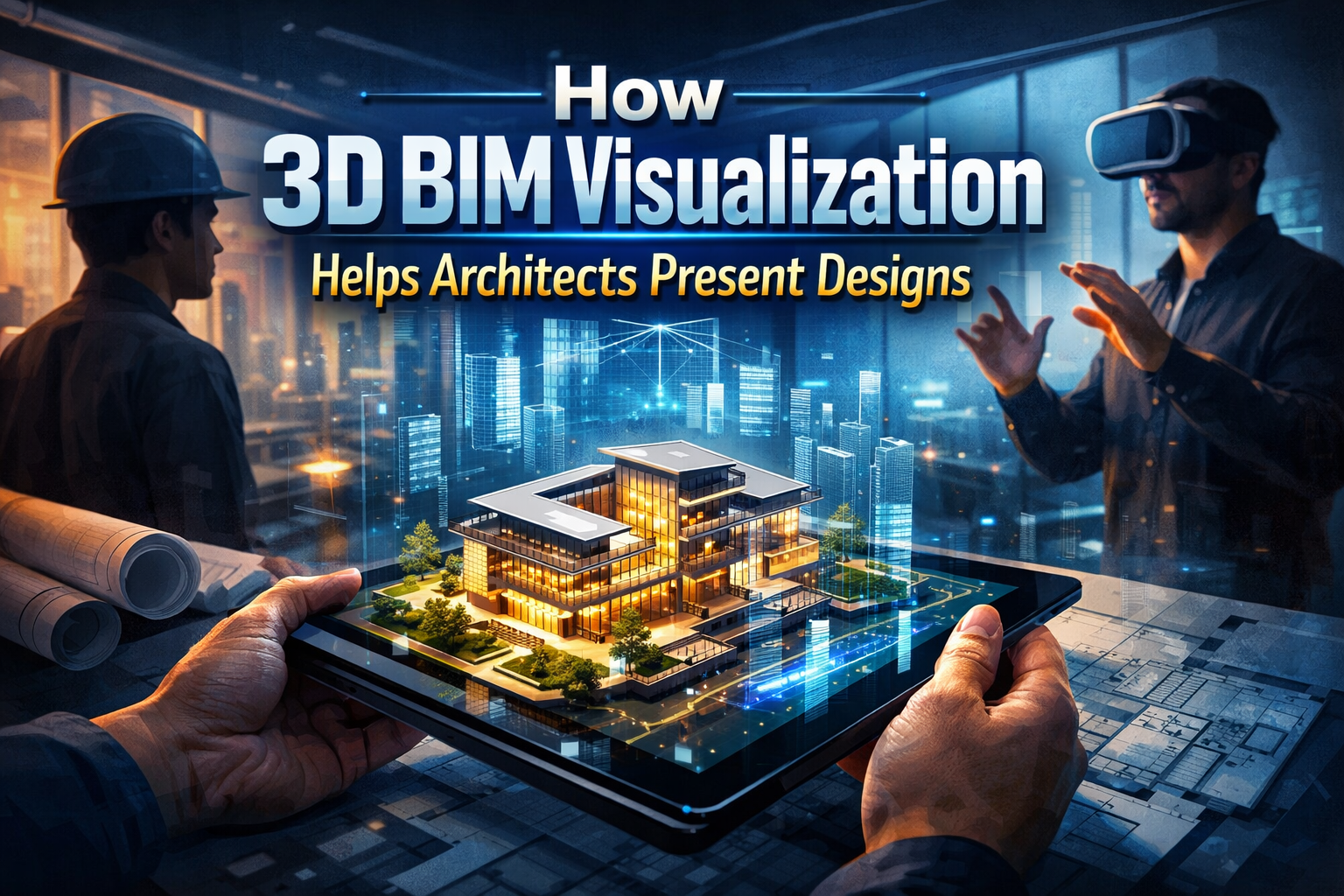
In modern architectural practice, 3D Building Information Modeling (BIM) visualization has become a transformative tool that reshapes how architects develop, communicate, and present design ideas. Beyond static blueprints and 2D drawings, 3D BIM visualization provides immersive renderings and real-time design explorations that enhance clarity, collaboration, and decision-making for both professionals and clients.
Bringing Design Concepts to Life Visually
Traditional architectural plans and elevations can be difficult for non-professionals to interpret. While experienced architects and engineers can mentally visualize spatial relationships from 2D drawings, clients often struggle to understand how those plans translate into actual spaces.
3D BIM visualization bridges this gap by providing realistic, three-dimensional representations of buildings that show geometry, materials, lighting, interior layouts, and surrounding context. Instead of interpreting lines and symbols, clients see lifelike digital models that feel tangible. This visual clarity helps clients:
Visualize spatial relationships and proportions.
Understand aesthetic and material choices.
Connect emotionally with the design early in the process.
For example, a 3D BIM walkthrough of a contemporary museum design can show how natural light moves through galleries during different times of day, something flat drawings cannot convey.
Enhancing Communication with Clients and Stakeholders
Architectural projects involve diverse stakeholders, including owners, developers, engineers, contractors, and regulators. Each group has unique concerns: owners focus on functionality and investment value, engineers on feasibility, and regulators on compliance.
3D BIM visualization creates a shared understanding by presenting a single, coherent visual model of the design that all parties can explore and interact with. With BIM, architects can:
Illustrate complex architectural forms simply.
Highlight key design features through interactive views.
Use 3D annotations to explain critical elements.
This reduces miscommunication and accelerates approvals. Stakeholders who might be unfamiliar with construction drawings appreciate visual realism, which leads to better feedback early in the design cycle.
Supporting Iterative Design and Rapid Feedback
Architectural design is rarely linear; ideas evolve through review, critique, and refinement. In traditional workflows, updating 2D drawings after feedback can be laborious, leading to delays and higher costs.
By contrast, 3D BIM visualization supports rapid iteration. Since BIM models contain both geometry and embedded data, changes propagate automatically across all views and schedules. Architects can:
Update design elements instantly.
Generate updated visualizations in real time.
Compare design options side by side.
For instance, if a client requests a change in façade treatment, the architect can adjust the model and immediately present the new look in realistic renderings. This agility improves client satisfaction and fosters collaborative decision-making.
Improving Accuracy Through Data-Rich Models
Unlike generic 3D graphics, BIM visualization is data-driven; every component includes structured information beyond geometry. This means that a window in a BIM model contains data about its type, dimensions, material, thermal properties, and fire performance.
This data richness benefits presentations in two keyways:
Consistency Across Deliverables: Visualizations, schedules, and cost estimates all derive from the same source model, reducing errors and discrepancies.
Informed Decision Making: Clients can visualize what design choices mean in terms of performance, such as energy consumption and daylighting, not just aesthetics.
Consequently, presentations become not only more persuasive but also more informed and defensible.
Enabling Realistic Visual Experiences
Advancements in rendering technology and real-time visualization tools allow architects to go beyond static renderings to create immersive experiences:
Photorealistic renders mimic materials, shadows, and lighting with high fidelity.
360° panoramas enable clients to inspect environments from within.
Virtual Reality (VR) puts clients inside the design for experiential understanding.
Augmented Reality (AR) overlays virtual design elements on real-world spaces.
These immersive experiences significantly improve how architectural designs are perceived. Clients get a visceral feel for scale, ambiance, and spatial quality that is impossible to achieve through technical drawings alone.
Facilitating Better Marketing and Business Development
BIM visualization is not only a design tool but also a powerful marketing asset. High-quality 3D visualizations help architects
Create compelling design portfolios.
Attract new clients with immersive presentations.
Showcase design innovation in competitions and pitches.
Investors and decision makers are more likely to commit to visually rich proposals where they clearly understand the design intent and the envisioned experience.
Enhancing Collaboration Across Disciplines
Architectural projects require coordination among multiple disciplines: structural engineers, MEP (mechanical, electrical, and plumbing) consultants, interior designers, landscape architects, and contractors. A shared 3D BIM model enables multidisciplinary teams to visualize how parts intersect and function together.
This coordinated visualization supports:
Clash detection and resolution before construction.
Better sequencing of construction activities.
Clearer interpretation of design intent by builders.
The result is reduced rework, fewer misunderstandings during construction, and smoother project delivery, all stemming from a unified visual language.
Supporting Sustainable and Performance-Driven Design
Sustainability is a central concern in contemporary architecture. BIM visualization supports performance analysis by integrating design with simulation tools. Architects can visualize:
Energy consumption estimates.
Daylight penetration and shading patterns.
Thermal comfort scenarios.
Passive design strategies.
By showing how design choices affect sustainability outcomes, BIM visualization empowers architects and clients to prioritize environmentally responsible solutions.
Conclusion
In an increasingly complex and competitive architectural environment, 3D BIM visualization has emerged as an indispensable asset for presenting designs. It enhances clarity, fosters collaboration, strengthens client engagement, and accelerates decision-making. By transforming abstract ideas into immersive, data-rich visual experiences, 3D BIM empowers architects to communicate design intent more effectively, ultimately leading to better outcomes for clients, teams, and communities.
FAQ’s
1. What is 3D BIM visualization in architecture?
3D BIM visualization refers to the process of creating realistic, data-rich visual representations of building designs using Building Information Modeling tools. Unlike traditional drawings, these models allow architects to present designs in an immersive and easily understandable format.
2. How does 3D BIM visualization improve client presentations?
3D BIM visualization helps clients better understand spatial layouts, materials, and design intent. Using tools like Autodesk Revit, architects can create detailed 3D views, walkthroughs, and renderings, making it easier for clients to visualize the final outcome before construction begins.
3. Can 3D BIM visualization reduce design errors?
Yes, 3D BIM visualization helps identify clashes and design inconsistencies early in the project. By working within a coordinated Building Information Modeling environment, architects can detect issues before they reach the construction stage, reducing costly errors and rework.
4. What technologies enhance 3D BIM visualization?
Technologies like Virtual Reality (VR) and Augmented Reality (AR) significantly enhance BIM visualization. They allow clients and stakeholders to experience designs interactively, providing a more engaging and realistic presentation.
5. Why is 3D BIM visualization important for modern architecture?
In today’s competitive design environment, 3D BIM visualization improves communication, speeds up approvals, and enhances decision-making. It bridges the gap between technical drawings and client expectations, ensuring that all stakeholders have a clear understanding of the project.
 301-774-0880
