
LOD 400 in BIM
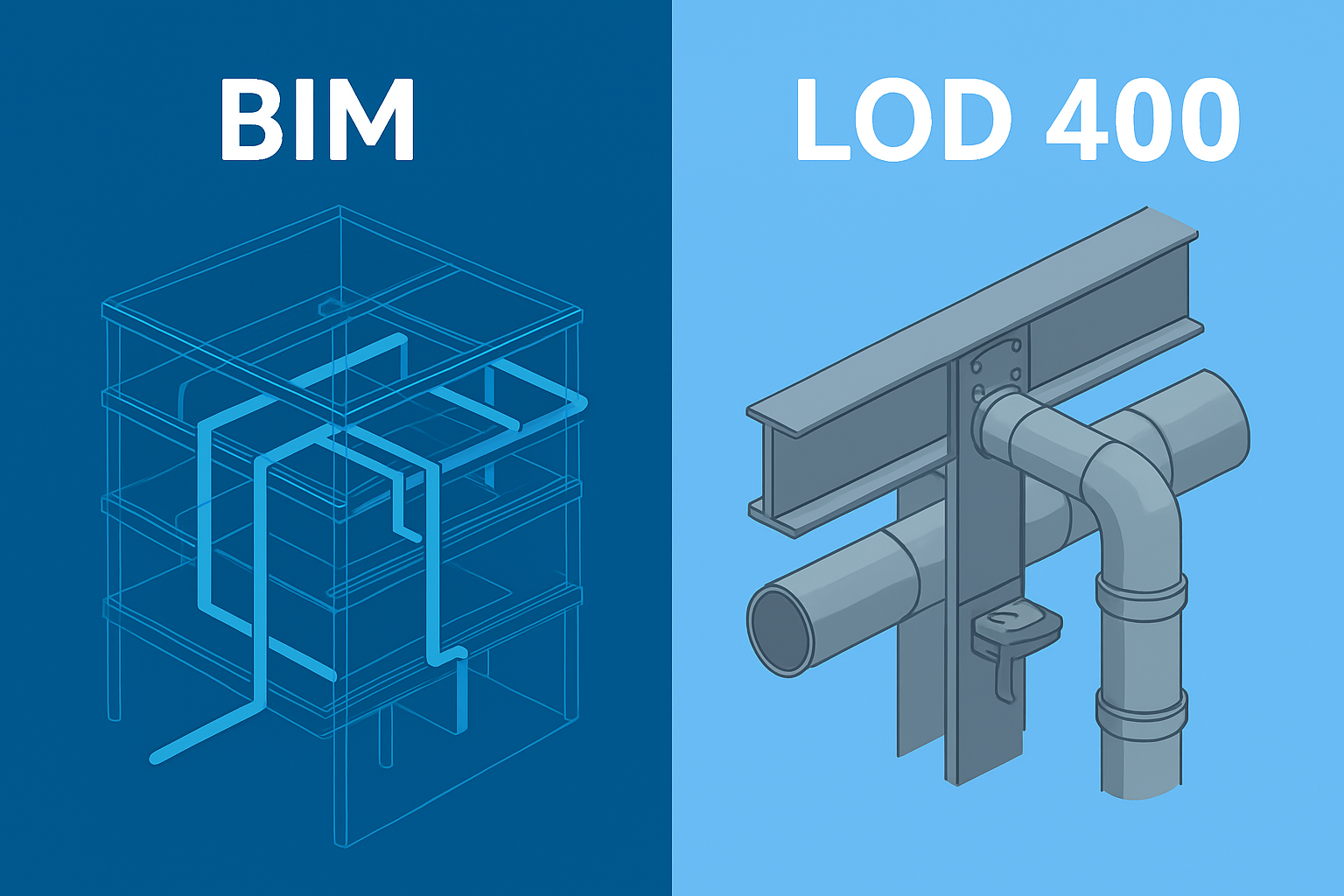
LOD 400, or Level of Development 400, is a highly detailed stage in BIM (Building Information Modeling) that represents the fabrication and assembly level of a building or infrastructure project. At this stage, elements are modeled with precise dimensions, connections, tolerances, and manufacturing specifications, making them ready for construction and fabrication. Unlike LOD 300, which primarily focuses on design intent, LOD 400 ensures that every component is detailed for actual installation and fabrication.
In essence, LOD 400 bridges the gap between virtual models and real-world construction, allowing architects, engineers, contractors, and fabricators to rely on the model as a constructible reference.
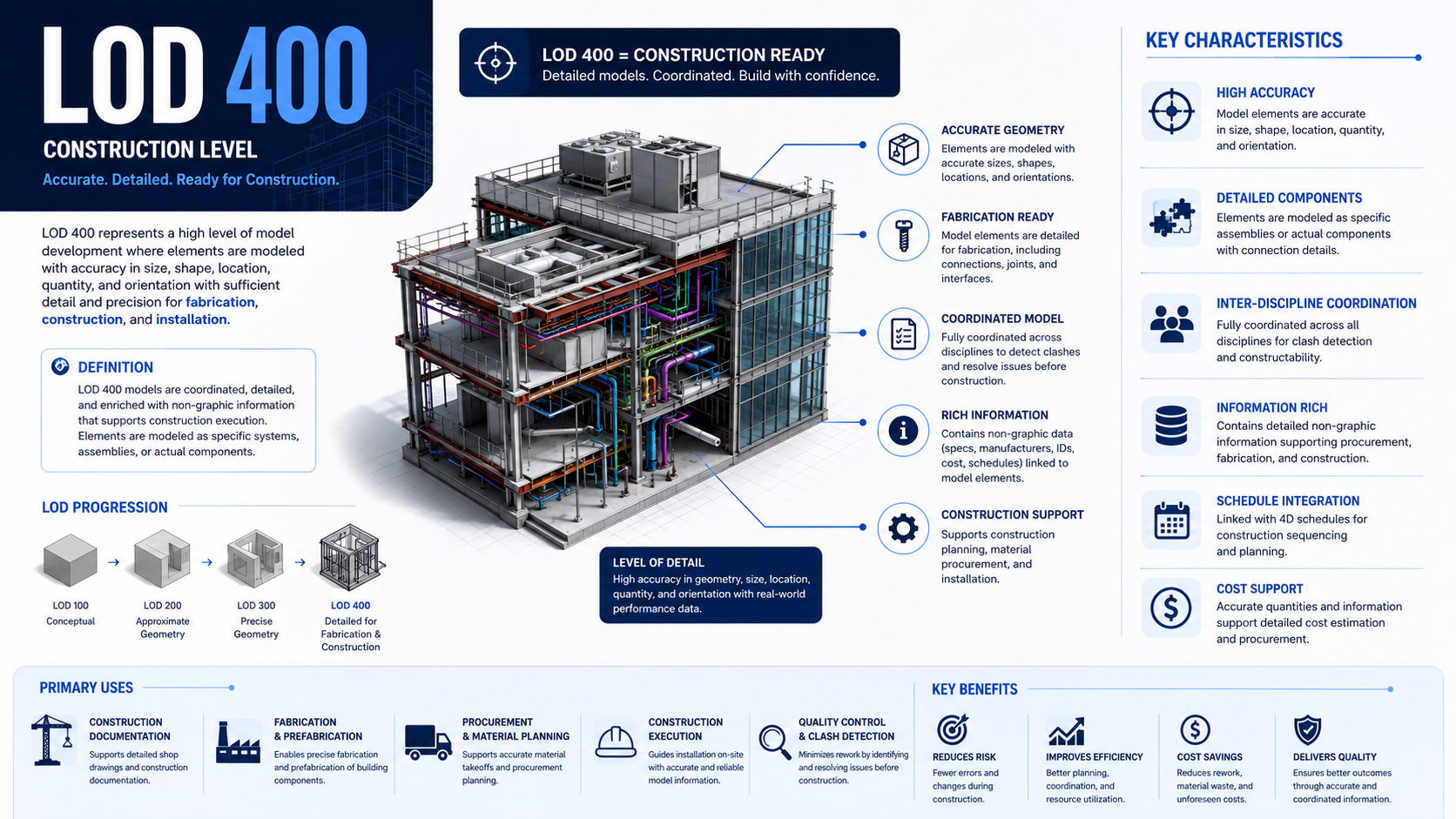
Key Features of LOD 400
Fabrication-Ready Components
LOD 400 models include highly detailed elements that are ready for manufacturing and construction. Each component—whether a structural beam, HVAC duct, or electrical conduit—is modeled with exact dimensions, material specifications, and connection details. For example, a steel beam in LOD 400 would include exact length, cross-section, bolt sizes, and weld locations, making it ready for fabrication without further interpretation.
Precise Geometry and Dimensions
At LOD 400, every element has accurate geometry and spatial positioning. This means not just approximate shapes, but exact placement, tolerances, and alignments that match real-world construction requirements. For instance, ductwork or piping will be modeled with the exact diameter, bends, and clearances needed for installation.
Integration Across Disciplines
LOD 400 models are coordinated across architectural, structural, and MEP systems, allowing teams to detect clashes and conflicts before fabrication. For example, a ceiling-mounted lighting system can be checked for interference with HVAC ducts or structural beams. This integrated approach ensures smooth collaboration between all stakeholders.
Construction and Assembly Details
Models at LOD 400 provide construction-specific information, such as connection types, assembly sequences, and fabrication tolerances. For instance, precast concrete panels will include detailed joint configurations, anchoring points, and reinforcement placement, supporting direct use for shop drawings and installation.
Material and Cost Data Embedded
Every element in an LOD 400 model carries material specifications, quantities, and cost information, enabling accurate procurement, budgeting, and project planning. For example, a plumbing system can list exact pipe lengths, fittings, and materials, which helps in cost estimation and ordering.
Advantages of LOD 400
High Construction Accuracy
LOD 400 provides fabrication-level detail, meaning every element in the model—structural beams, MEP components, or architectural assemblies—is represented with exact dimensions, materials, and connections. This level of detail allows contractors and fabricators to rely on the model for actual construction and installation, significantly reducing the risk of errors or misinterpretations on-site. For example, a steel beam modeled at LOD 400 will include the exact size, bolt locations, and weld details, ensuring it fits perfectly during assembly.
Enhanced Coordination Across Disciplines
With LOD 400, structural, mechanical, electrical, and plumbing elements are all modeled in high detail and integrated into a single BIM environment. This allows project teams to detect clashes and conflicts between systems before construction begins. For instance, an HVAC duct that might interfere with a ceiling beam can be identified and resolved digitally, preventing costly rework.
Facilitates Prefabrication and Modular Construction
LOD 400 models are fabrication-ready, which means components can be prefabricated off-site with confidence. Walls, floor panels, or MEP units can be manufactured according to the exact specifications in the model. This reduces on-site labor, speeds up construction schedules, and minimizes material waste, leading to more efficient project execution.
Accurate Cost Estimation and Procurement
Because every component is modeled with precise quantities, materials, and specifications, LOD 400 supports highly accurate cost estimation. Contractors can determine the exact number of bolts, ducts, pipes, or panels required for the project, helping in budgeting, procurement, and avoiding material shortages. This is particularly useful in large-scale projects where cost overruns can have significant impacts.
Streamlined Construction Documentation
LOD 400 allows for automatic generation of shop drawings, assembly diagrams, and installation instructions directly from the model. This reduces the need for manual drafting and ensures that fabrication and installation processes align perfectly with the design intent. For example, a detailed pipe routing plan extracted from a LOD 400 model can guide onsite workers in exact alignment and connection of MEP systems.
Limitations of LOD 400
High Modeling Effort and Time-Intensive
Creating a LOD 400 model requires extensive detail for every component, including dimensions, connections, fabrication tolerances, and materials. This makes the modeling process time-consuming compared to lower levels of development such as LOD 200 or 300. For example, modeling every bolt, weld, or HVAC connection in a large commercial building can take significant effort from experienced BIM modelers.
Specialized Software and Expertise Required
LOD 400 modeling demands advanced BIM software capabilities and a deep understanding of structural, mechanical, electrical, and plumbing systems. Not every design or construction team may have the necessary expertise, which can limit adoption. For instance, detailed steel fabrication models require proficiency in software like Revit, Tekla, or Navisworks, and knowledge of industry fabrication standards.
Potential Model Complexity
Due to the high level of detail, LOD 400 models can become very large and complex, which may affect software performance and collaboration. Large models with thousands of components can slow down computers and cloud-based collaboration tools, making it challenging for multiple team members to work simultaneously.
Limited Use in Early Design Phases
LOD 400 is not practical during schematic or conceptual design, where many decisions about materials, connections, and system layouts are still undecided. Using LOD 400 too early can result in wasted effort, as major design changes may require re-modeling the highly detailed components.
Higher Initial Costs
Producing fabrication-ready models at LOD 400 requires more time, skilled personnel, and software investment, which can increase project costs upfront. While these costs are often offset by reduced errors, material waste, and construction time, smaller projects or organizations with limited budgets may find LOD 400 less feasible.
Conclusion
LOD 400 represents the pinnacle of BIM development for construction and fabrication, providing a model that is not only visually accurate but also functionally ready for the real world. While it demands higher effort, expertise, and software capabilities, the benefits of accuracy, coordination, cost efficiency, and prefabrication make LOD 400 indispensable for complex construction projects. It ensures that the digital model seamlessly translates into physical reality, reducing errors, saving time, and improving overall project outcomes.
FAQ’S
1. What is LOD 400 in BIM?
LOD 400 represents the fabrication and construction stage in Building Information Modeling, where model elements are developed with highly detailed geometry and precise information required for manufacturing and installation.
2. What level of detail is included in LOD 400?
At LOD 400, elements include accurate sizes, shapes, connections, fabrication details, and assembly information. Components such as ducts, pipes, and structural elements are modeled exactly as they will be built on-site.
3. How is LOD 400 used in construction projects?
LOD 400 is used for shop drawings, prefabrication, and on-site installation. Contractors and fabricators rely on this level to ensure components are produced and installed correctly.
4. Who typically works with LOD 400 models?
LOD 400 models are primarily used by contractors, fabricators, BIM modelers, and installation teams who need precise details for construction execution.
5. What is the difference between LOD 300 and LOD 400?
While LOD 300 includes accurate geometry and placement for design coordination, LOD 400 goes further by adding fabrication-level details such as connections, supports, and installation requirements, making it suitable for actual construction.

Send us
drawings and scope
Click the link below and send us your complete scope and drawings. We will provide quote/proposal in 24 to 48 hours.
 301-774-0880
