
Open BIM vs Closed BIM: Which Approach Is Better?
Introduction
Building Information Modeling (BIM) has become the foundation of modern construction in the United States, enabling architects, engineers, contractors, fabricators, and facility managers to collaborate on increasingly complex projects. From high-rise commercial buildings and healthcare facilities to airports, educational campuses, and industrial plants, BIM has transformed how buildings are designed, coordinated, constructed, and managed.
However, as BIM adoption continues to grow across the U.S. Architecture, Engineering, and Construction (AEC) industry, one important question continues to shape project workflows:
Should project teams adopt Open BIM or Closed BIM?
The answer is not always straightforward. Some organizations prefer proprietary software ecosystems that offer seamless integration within a single platform, while others prioritize interoperability and open standards that allow multiple software applications to work together.
Understanding the differences between Open BIM and Closed BIM is essential for project owners, architects, engineers, contractors, and BIM managers seeking to maximize collaboration, reduce project risks, and improve long-term asset management.
Understanding BIM Collaboration
BIM is more than creating intelligent 3D models. It is a collaborative process where multiple disciplines contribute specialized information to develop a coordinated digital representation of a building.
Typical project participants include:
- Architects.
- Structural engineers.
- Mechanical engineers.
- Electrical engineers.
- Plumbing consultants.
- Fire protection designers.
- Civil engineers.
- Steel detailers.
- Contractors.
- Fabricators.
- Facility managers.
Because these stakeholders often use different software platforms, the ability to exchange accurate project information becomes critical.
This is where Open BIM and Closed BIM differ significantly.
What Is Open BIM?
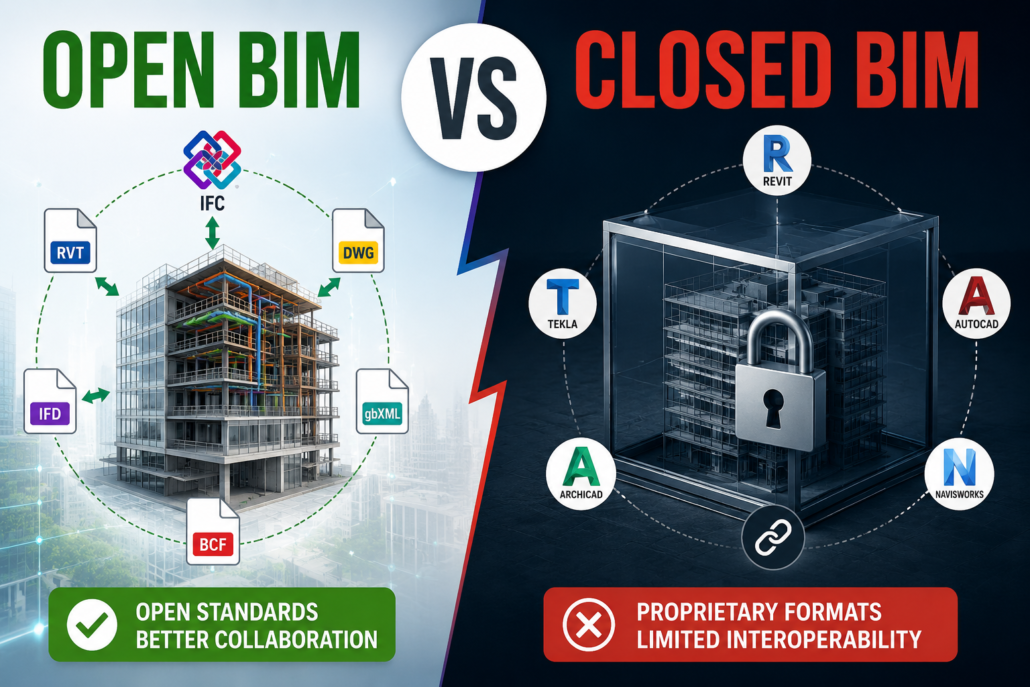
Open BIM is a collaborative approach based on open, vendor-neutral standards that allow project data to be shared across different BIM software applications.
Instead of requiring every participant to use the same software, Open BIM enables teams to exchange information using standardized file formats such as:
- IFC (Industry Foundation Classes).
- BCF (BIM Collaboration Format).
- COBie (Construction Operations Building Information Exchange).
This flexibility allows each organization to continue using the software best suited to its discipline while maintaining interoperability across the project.
What Is Closed BIM?
Closed BIM refers to workflows where project teams primarily use software products from the same vendor or within a proprietary ecosystem.
Because applications are designed to work together, data exchange is generally more seamless, reducing the need for file conversions or interoperability standards.
For example, a project team may use a single software ecosystem for:
- Architectural modeling.
- Structural modeling.
- MEP design.
- Quantity takeoffs.
- Clash detection.
- Construction documentation.
- Project coordination.
Closed BIM focuses on maximizing integration within a controlled software environment.
Why This Matters in the U.S. Construction Industry
Construction projects in the United States often involve dozens—or even hundreds—of companies working together.
A typical commercial project may include:
- An architect using one BIM platform.
- Structural consultants using another.
- Steel fabricators using specialized detailing software.
- MEP contractors using fabrication tools.
- Facility managers requiring asset management systems.
If project information cannot move efficiently between these systems, teams may experience:
- Data loss.
- Duplicate modeling.
- Coordination errors.
- Delayed approvals.
- Increased project costs.
Selecting the right BIM strategy is therefore essential for project success.
Open BIM Advantages
Greater Software Flexibility
One of the biggest strengths of Open BIM is freedom of choice.
Every project participant can use software that best fits their expertise without forcing the entire team into a single software ecosystem.
This flexibility is particularly valuable on large U.S. infrastructure and public-sector projects where consultants often work with different technology platforms.
Improved Collaboration
Open standards encourage collaboration among multiple organizations.
Rather than recreating models from scratch, participants can exchange information throughout the project lifecycle.
This reduces:
- Duplicate work.
- Manual data entry.
- Communication gaps.
- Coordination delays.
Long-Term Data Accessibility
Buildings often remain in service for 50 years or more.
Software vendors and file formats may change over time.
Open BIM helps preserve project information by storing data in internationally recognized formats rather than relying exclusively on proprietary software.
This is especially valuable for facility management and future renovations.
Better Support for Public Projects
Many U.S. government agencies and public institutions increasingly encourage or require open data standards to ensure long-term accessibility and avoid vendor lock-in.
Open BIM provides greater transparency for owners managing public assets.
Closed BIM Advantages
Seamless Software Integration
Because applications within the same ecosystem are designed to work together, data exchange is generally smoother.
Benefits include:
- Faster synchronization.
- Fewer import/export issues.
- Consistent object behavior.
- Simplified workflows.
For teams already standardized on one software platform, Closed BIM can improve day-to-day productivity.
Easier Training and Support
Organizations using a single software ecosystem often benefit from:
- Standardized workflows.
- Consistent user interfaces.
- Unified technical support.
- Simplified employee training.
This can reduce onboarding time for new team members.
Faster Project Coordination
When all disciplines work in the same environment, coordination becomes more efficient.
Changes made by one team are often reflected more quickly across related models, reducing coordination delays.
Better Native Functionality
Native software files generally retain:
- Parametric relationships.
- Families and components.
- Material properties.
- Constraints.
- Intelligent object behavior.
Some of this information may be simplified when exported to open exchange formats.
Comparing Open BIM and Closed BIM
| Feature | Open BIM | Closed BIM |
|---|---|---|
| Software flexibility | Excellent | Limited |
| Vendor independence | High | Low |
| Interoperability | High | Moderate |
| Native software performance | Moderate | Excellent |
| Collaboration across organizations | Excellent | Good |
| Long-term data accessibility | Excellent | Moderate |
| Training simplicity | Moderate | Excellent |
| Vendor lock-in | Minimal | Higher |
| Public-sector suitability | Excellent | Good |
| Multi-software coordination | Excellent | Limited |
Common Challenges with Open BIM
Although Open BIM offers significant advantages, it is not without challenges.
Some exported models may experience:
- Missing object properties.
- Geometry translation issues.
- Reduced parametric intelligence.
- Classification inconsistencies.
- Mapping errors between software platforms.
These issues are becoming less common as interoperability standards continue to improve, but careful quality control remains essential.
Challenges with Closed BIM
Closed BIM environments also present limitations.
Organizations may encounter:
- Dependence on a single software vendor.
- Higher licensing costs.
- Limited flexibility when hiring consultants.
- Difficulty collaborating with external partners using different platforms.
- Long-term concerns regarding proprietary data formats.
For projects involving multiple independent firms, these limitations can become significant.
Open BIM and U.S. Design-Build Projects
Design-build delivery continues to expand across the United States.
These projects emphasize collaboration between designers and contractors from the earliest project stages.
Open BIM supports this approach by allowing each participant to contribute using their preferred software while maintaining coordinated project information.
This flexibility is particularly valuable on large commercial developments, transportation projects, healthcare facilities, and industrial construction.
Open BIM for Facility Management
Owners increasingly expect BIM models to deliver value long after construction ends.
Open BIM supports facility management through standardized data that can integrate with:
- Computerized Maintenance Management Systems (CMMS).
- Building Management Systems (BMS).
- Digital twins.
- Asset management platforms.
- Space management software.
Vendor-neutral data improves long-term usability throughout the building lifecycle.
When Closed BIM May Be the Better Choice
Closed BIM can be highly effective when:
- All consultants use the same software platform.
- Projects are relatively small or medium in scale.
- Teams require maximum native software functionality.
- Organizations have standardized workflows.
- Long-term interoperability is not a primary concern.
Many private developers successfully use Closed BIM because of its simplicity and efficient coordination within established software ecosystems.
When Open BIM Is the Better Choice
Open BIM is generally the preferred approach when:
- Multiple organizations use different BIM software.
- Public-sector projects require open standards.
- Long-term asset management is important.
- Facility owners want vendor-neutral building data.
- International consultants are involved.
- Teams prioritize flexibility and collaboration over software standardization.
Large U.S. infrastructure, healthcare, airport, university, and government projects frequently benefit from Open BIM workflows.
Best Practices for Successful BIM Collaboration
Regardless of whether a project uses Open BIM or Closed BIM, success depends on clear planning and coordination.
Recommended practices include:
- Develop a comprehensive BIM Execution Plan (BEP).
- Establish file naming and version control standards.
- Define responsibilities for each discipline.
- Perform regular model coordination and clash detection.
- Validate exchanged models before coordination meetings.
- Maintain consistent object classifications.
- Schedule periodic quality assurance reviews.
These practices help reduce errors and improve collaboration across the project lifecycle.
The Future of BIM in the United States
The U.S. construction industry is moving toward greater interoperability as digital project delivery becomes standard practice. Emerging technologies such as cloud-based collaboration, digital twins, artificial intelligence, and automated code checking all depend on reliable information exchange between different software platforms.
Rather than viewing Open BIM and Closed BIM as competing approaches, many organizations are adopting hybrid workflows. They use proprietary software for modeling and discipline-specific tasks while relying on open standards like IFC and COBie for collaboration, project handover, and facility management. This balanced strategy combines the efficiency of native software with the flexibility of vendor-neutral data exchange.
Conclusion
The choice between Open BIM and Closed BIM depends on project goals, team structure, owner requirements, and long-term asset management needs. Closed BIM offers streamlined workflows, seamless software integration, and excellent native functionality for teams working within a single software ecosystem. Open BIM, on the other hand, promotes interoperability, vendor independence, and collaboration across diverse software platforms, making it particularly valuable for large, multidisciplinary projects in the United States.
As the U.S. AEC industry embraces digital transformation, interoperability is becoming a strategic advantage rather than a technical preference. Organizations that understand when to use Open BIM, Closed BIM, or a hybrid approach will be better equipped to deliver efficient, coordinated, and future-ready construction projects while meeting the evolving demands of owners, contractors, and facility managers.
 301-774-0880