
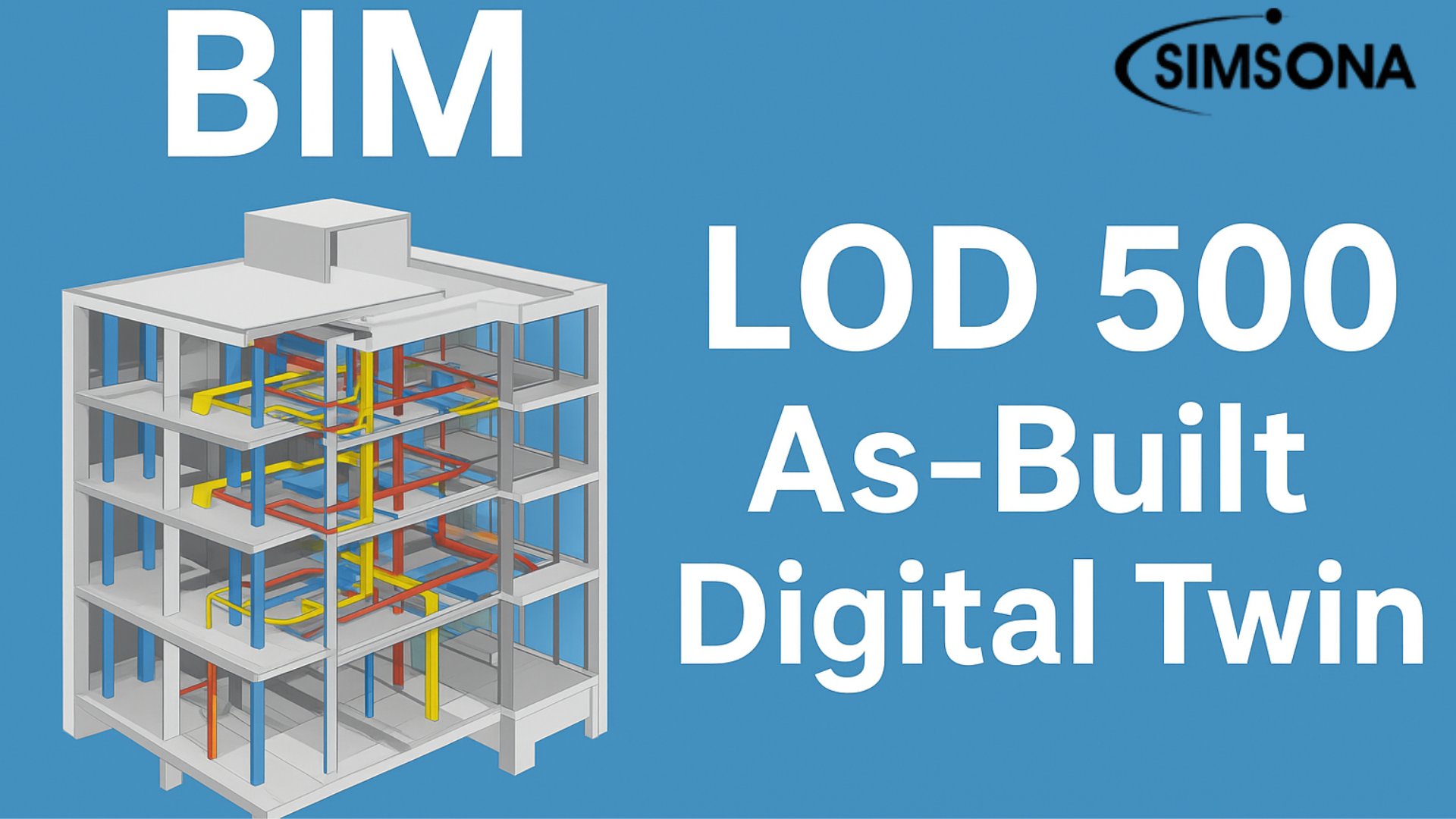
Understanding LOD 500 in BIM
LOD 500, also known as the as-built level of development in Building Information Modeling (BIM), represents the highest degree of accuracy and completion in a digital model. Unlike earlier levels such as LOD 300 or LOD 400, which focus on design intent and fabrication details, LOD 500 provides a true reflection of the constructed building or infrastructure. It incorporates as-built data, verified field conditions, and precise dimensions, making it invaluable for facility managers, owners, and operators.
Key Features of LOD 500
Field-Verified Accuracy
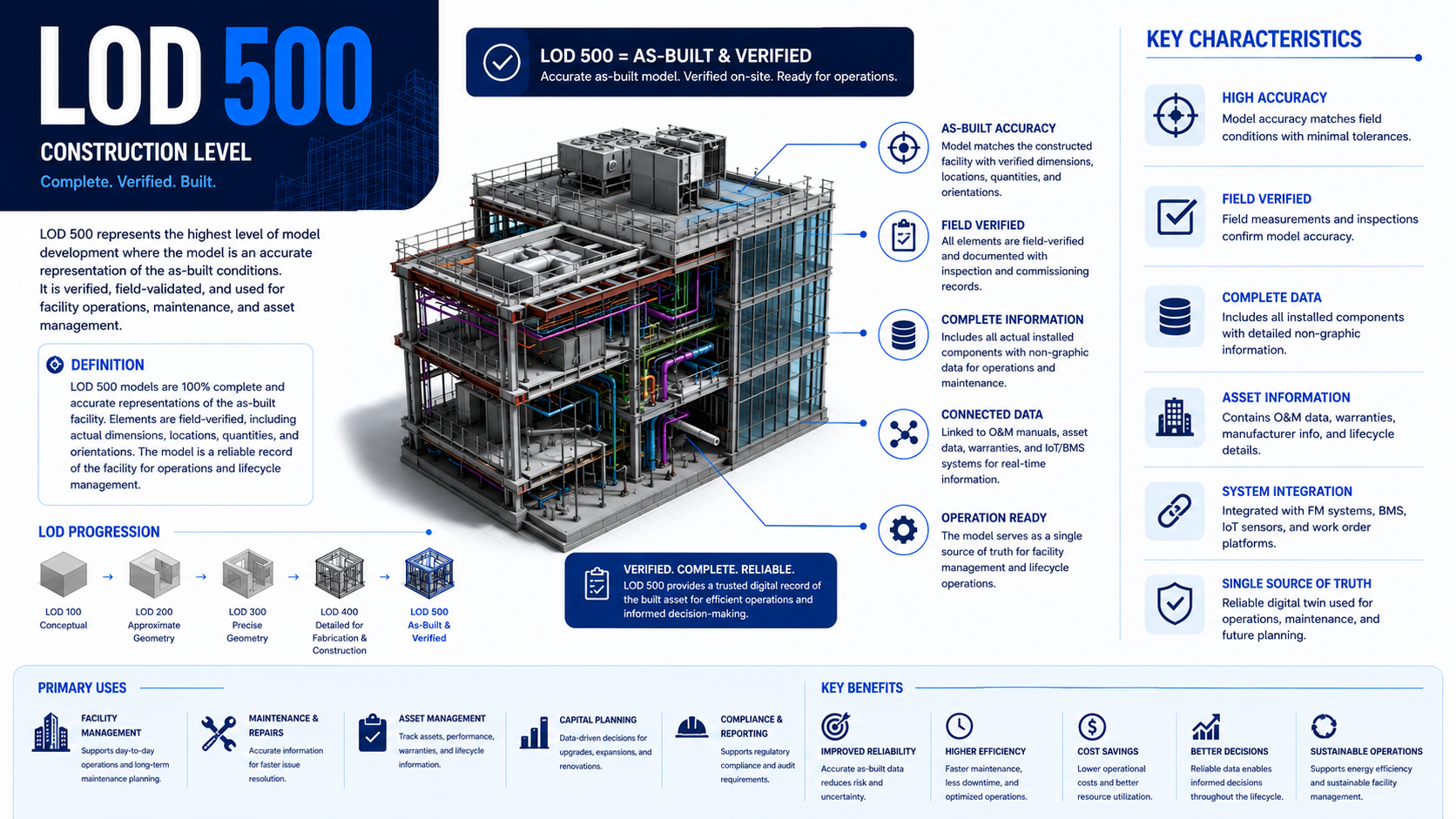
The most defining feature of LOD 500 is its as-built precision. Unlike earlier levels such as LOD 300 or LOD 400, which reflect design intent or fabrication details, LOD 500 captures the exact conditions of the completed building. This accuracy is achieved using laser scanning, photogrammetry, and reality capture technologies, ensuring that every wall, column, beam, and MEP element aligns perfectly with what has been physically constructed on-site. For facility managers and owners, this level of detail eliminates discrepancies between design and reality, reducing future conflicts.
Rich Asset Information
Another significant feature of LOD 500 is the integration of detailed asset metadata. Each building component—whether an HVAC unit, electrical switchboard, or plumbing valve—is linked with information such as manufacturer details, installation date, warranty records, and maintenance history. This transforms the BIM model into a digital twin, enabling seamless tracking of equipment performance and simplifying preventive maintenance. It also ensures compliance with safety and operational standards, particularly in complex facilities like hospitals and airports.
Lifecycle Utility
LOD 500 is not just for construction handover but serves as a long-term resource throughout the building’s lifecycle. By providing accurate as-built data, the model becomes invaluable during operations, renovations, retrofits, and expansions. For example, in a commercial building undergoing space reconfiguration, the LOD 500 model helps designers and engineers plan modifications without conducting fresh site surveys, saving both time and resources.
Integration with Facility Management Systems
A critical feature of LOD 500 is its ability to integrate with CAFM (Computer-Aided Facility Management), CMMS (Computerized Maintenance Management Systems), and IWMS (Integrated Workplace Management Systems). This connectivity allows facility managers to monitor energy consumption, plan space utilization, and schedule maintenance activities directly from the digital model. The interoperability makes LOD 500 not just a static model but a dynamic operational tool.
Multidisciplinary Coordination
LOD 500 also enhances coordination between architectural, structural, and MEP systems. Since the model reflects actual site conditions, it serves as a single source of truth for all disciplines involved in the building’s operation. Facility teams can rely on the model for accurate decision-making, whether it’s replacing a critical component, planning an upgrade, or integrating smart building technologies.
Advantages of LOD 500
Facility Management Integration
With precise as-built data, LOD 500 models seamlessly integrate with Computer-Aided Facility Management (CAFM) and Integrated Workplace Management Systems (IWMS). This allows facility teams to track energy use, space utilization, and asset performance.
Reduced Maintenance Costs
Since LOD 500 provides accurate component information, operators can plan preventive maintenance and avoid costly emergency repairs. For example, knowing the exact valve location in a plumbing system helps maintenance crews save time during breakdowns.
Supports Renovation and Retrofit Projects
When a building undergoes renovation or adaptive reuse, LOD 500 acts as a digital twin. Architects and engineers can rely on the as-built model to design modifications without extensive site surveys.
Improved Asset Tracking
LOD 500 links every asset, from HVAC units to lighting systems, with its operational data. This enhances asset lifecycle tracking, ensuring sustainability and optimized performance.
Limitations of LOD 500
While LOD 500 is highly beneficial, it comes with certain challenges:
High Cost and Time Investment
Developing a fully verified as-built model requires advanced scanning equipment and skilled BIM professionals.
Data Overload
Facility managers may face difficulty managing and updating the vast amount of information embedded in LOD 500.
Not Needed for All Projects
Smaller projects or those with short lifespans may not justify the cost of creating a full LOD 500 model.
Conclusion
LOD 500 represents the pinnacle of BIM accuracy. It is not just a design or construction tool, but a lifecycle management resource that empowers owners and facility managers with actionable insights. By providing a complete, field-verified as-built digital twin of the physical structure, LOD 500 helps in sustainability, cost efficiency, and long-term asset optimization.
As the AEC (Architecture, Engineering, and Construction) industry continues to embrace digital transformation, LOD 500 is set to play a vital role in smart facility management and infrastructure modernization.
FAQ’S
1. What is LOD 500 in BIM?
LOD 500 represents the as-built stage in Building Information Modeling, where model elements reflect the actual constructed conditions with verified geometry and real-world data.
2. What type of information is included in LOD 500?
LOD 500 includes accurate field-verified dimensions, locations, installed components, serial numbers, maintenance data, and operational details required for facility management.
3. What is the purpose of LOD 500 models?
The main purpose of LOD 500 is to support operations, maintenance, and facility management. It provides a reliable digital representation of the building for long-term use.
4. Who uses LOD 500 models?
LOD 500 models are primarily used by facility managers, building owners, and maintenance teams to manage assets, schedule repairs, and track system performance.
5. How is LOD 500 different from LOD 400?
While LOD 400 focuses on fabrication and installation details, LOD 500 reflects the final constructed condition with verified data, making it suitable for post-construction use and lifecycle management.

Send us
drawings and scope
Click the link below and send us your complete scope and drawings. We will provide quote/proposal in 24 to 48 hours.
 301-774-0880
