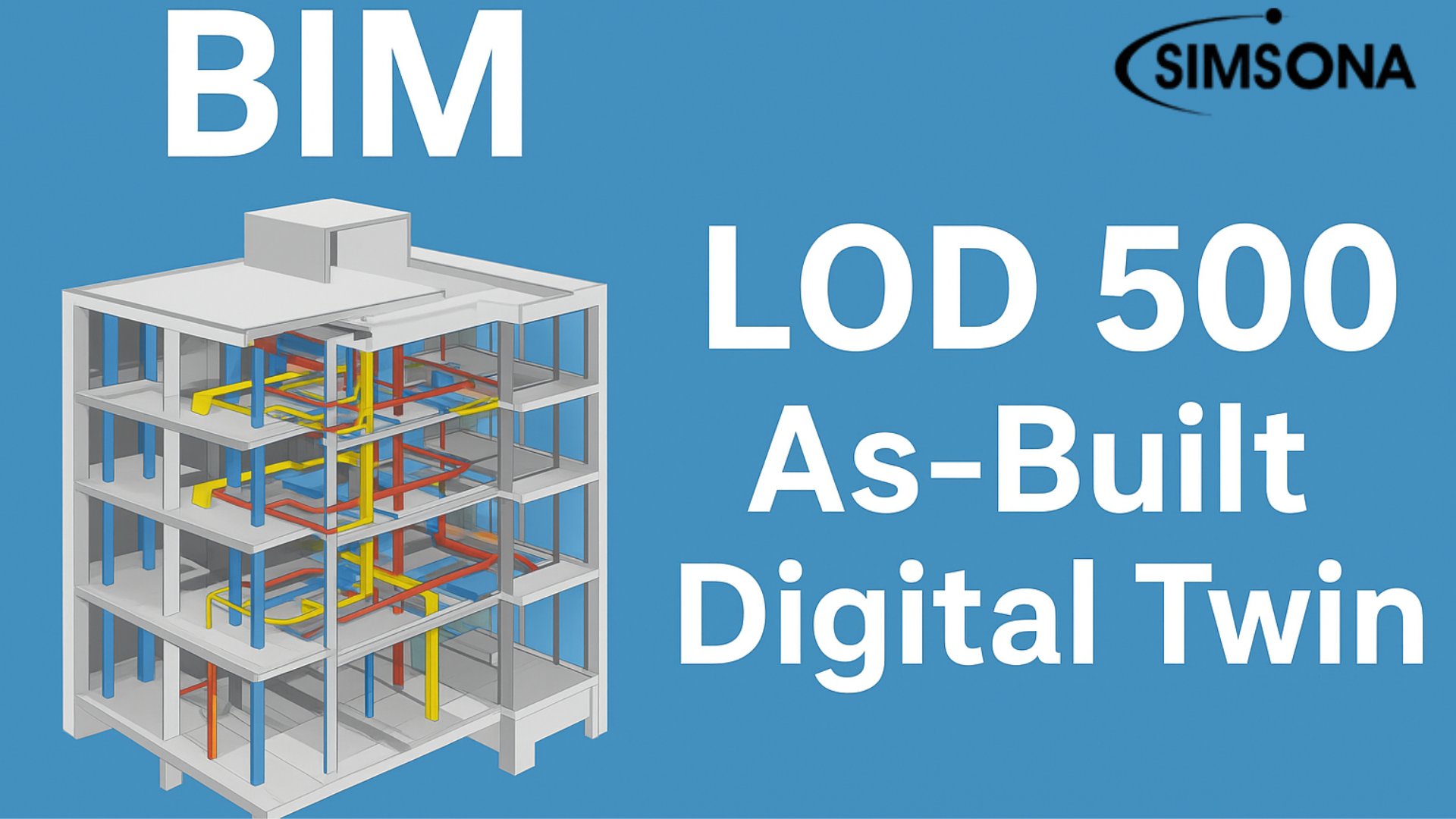
Understanding LOD 300 in BIM
Building Information Modeling (BIM) has revolutionized the architecture, engineering, and construction (AEC) industry by enabling precise digital representations of physical and functional building elements. Among the various Levels of Development (LOD), LOD 300 holds a crucial place for project coordination, design verification, and construction documentation.
What is LOD 300?
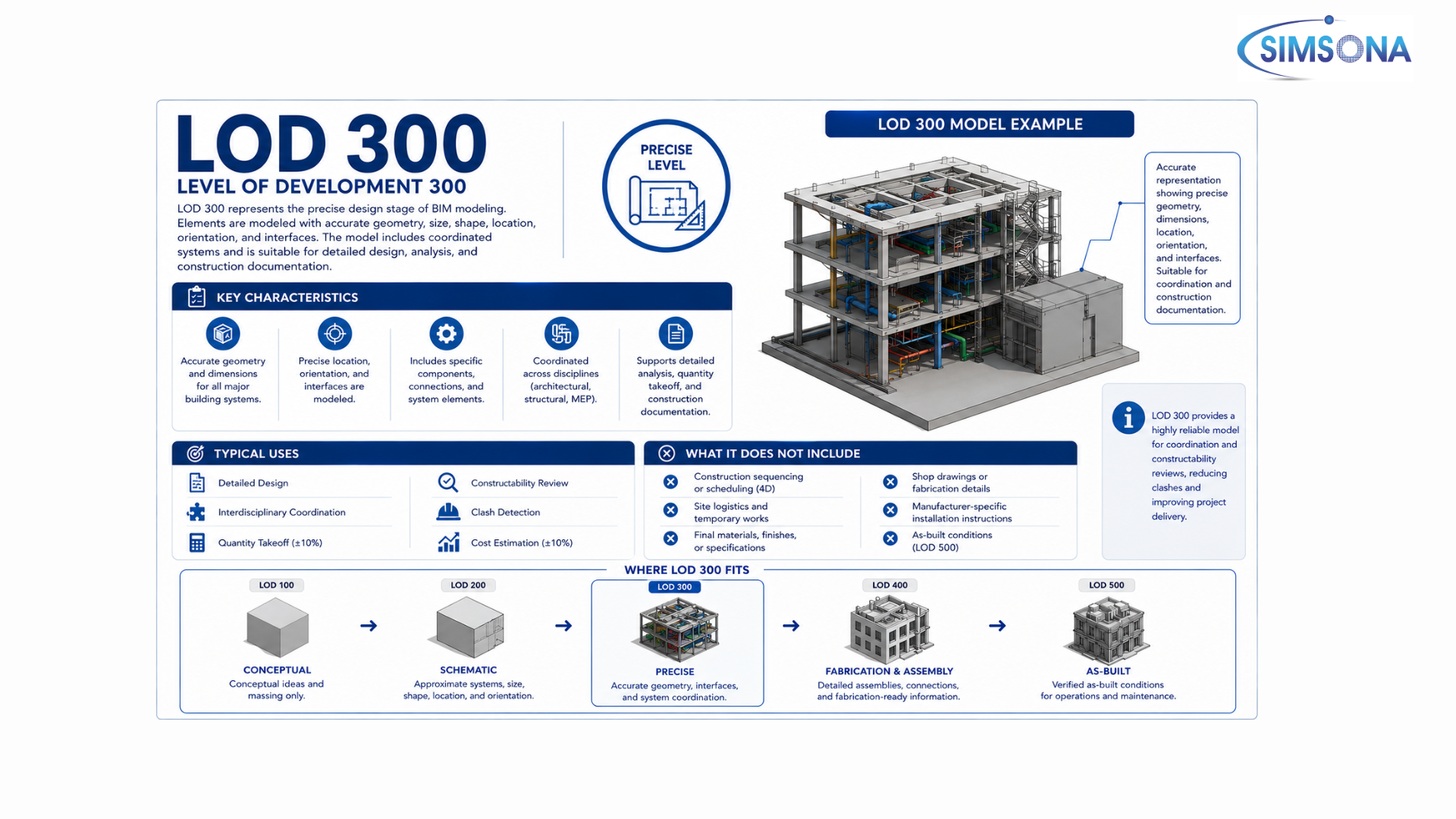
LOD 300 refers to a Level of Development where building elements are represented with accurate geometry, quantity, size, shape, and orientation suitable for construction purposes. At this stage, elements are modeled with sufficient detail to generate construction documents, shop drawings, and fabrication information. Unlike LOD 100 and LOD 200, which focus on conceptual and approximate designs, LOD 300 provides precise and measurable representations that reflect what will actually be built on site.
LOD 300 serves as a bridge between design intent and actual construction, making it critical for engineers, architects, and contractors.
Key Features of LOD 300
Accurate Geometry
At LOD 300, each element in the BIM model is modeled with exact dimensions, shape, and orientation. Unlike LOD 100 or 200, which may use generic placeholders or approximate sizes, LOD 300 represents elements realistically and in constructable form.
Precise Quantity and Size
The model allows for reliable extraction of quantities for materials and components. This is essential for cost estimation and procurement planning.
Exact Location and Position
Each element is accurately positioned within the model, coordinated with other building systems. This ensures minimal clashes and precise alignment across disciplines.
Parametric Information
Elements in LOD 300 can include metadata such as material type, manufacturer, performance specifications, and fire ratings. This makes the model a reliable source for detailed planning and design decisions.
Coordination Ready
LOD 300 models are detailed enough for clash detection and interdisciplinary coordination. Conflicts between architectural, structural, and MEP systems can be identified and resolved before construction begins.
Advantages of LOD 300
Accurate Construction Documentation
LOD 300 provides precise dimensions and geometry, which can be directly used to produce construction drawings and shop drawings. This reduces ambiguity and errors during construction.
Reliable Quantity Take-offs
Because elements are modeled with exact size, shape, and material, quantities for materials can be accurately extracted, aiding in cost estimation and procurement.
Improved Coordination
LOD 300 enables interdisciplinary coordination among architecture, structural, and MEP systems. This allows early detection of clashes and reduces conflicts on-site.
Facilitates Cost Estimation
With precise geometry and quantities, LOD 300 models support more accurate budgeting and cost planning, reducing financial risks during the project lifecycle.
Supports Design Validation
LOD 300 allows stakeholders to visualize and validate the design before construction, ensuring that all systems fit together as intended.
Limitations of LOD 300
Not Fully Fabrication-Ready
Although LOD 300 provides accurate dimensions and geometry, it may not include every detail required for fabrication or installation. Some elements still need additional refinement in LOD 400 or 500.
Requires High Modeling Effort
Creating an LOD 300 model is more time-consuming and labor-intensive compared to LOD 100 or 200 because every element must have accurate geometry, size, and location.
Still Prone to Design Changes
Since LOD 300 models are developed before final design freeze, they can still be affected by design changes. Updating all elements to maintain accuracy can be challenging.
Higher Software and Hardware Requirements
LOD 300 models are more detailed and data-heavy, which can require advanced BIM software and more powerful hardware for smooth visualization and coordination.
Limited to Construction Planning
While LOD 300 supports coordination, cost estimation, and construction planning, it is not sufficient for precise fabrication, installation, or as-built verification. For these tasks, LOD 400 and LOD 500 are required.
Potential for Clash Overlook
Although LOD 300 is coordination-ready, not all small-scale clashes may be captured, especially in highly detailed MEP systems, which require LOD 350 or higher for more precise clash detection.
Conclusion
LOD 300 is a critical stage in BIM that transitions designs from conceptual models to detailed, construction-ready representations. It ensures precise geometry, accurate quantities, and proper material information, making it indispensable for design verification, coordination, and construction planning. While it demands more effort and careful management, the benefits of improved accuracy, collaboration, and project efficiency make LOD 300 a cornerstone in modern BIM workflows.
Faq’s
1. What is LOD 300 in BIM?
LOD 300 represents the detailed design stage in Building Information Modeling, where elements are modeled with accurate geometry, size, shape, location, and orientation suitable for coordination and documentation.
2. What level of detail is included in LOD 300?
At LOD 300, elements include precise dimensions, quantities, and placement. Components such as walls, beams, ducts, and pipes are modeled accurately to reflect real-world conditions.
3. What is the purpose of LOD 300 models?
LOD 300 models are used for design coordination, clash detection, and construction documentation. They provide reliable information for generating drawings and performing quantity takeoffs.
4. Can LOD 300 be used for construction?
LOD 300 supports construction planning and coordination but is not sufficient for fabrication. It lacks the detailed connections and installation information required for on-site execution.
5. How does LOD 300 differ from LOD 200 and LOD 400?
Compared to LOD 200, LOD 300 has accurate and finalized geometry rather than approximate elements. Compared to LOD 400, it does not include fabrication or installation-level details, making it more suitable for coordination than execution.

Send us
drawings and scope
Click the link below and send us your complete scope and drawings. We will provide quote/proposal in 24 to 48 hours.
 301-774-0880