
Understanding LOD 200 in BIM
Building Information Modeling (BIM) has revolutionized the way architects, engineers, and construction professionals design, plan, and manage building projects. Among the different Levels of Development (LOD), LOD 200 plays a crucial role in bridging conceptual designs with detailed planning. It provides a framework that allows project stakeholders to visualize, analyze, and coordinate building components effectively before moving to more detailed LOD stages.
What is LOD 200?
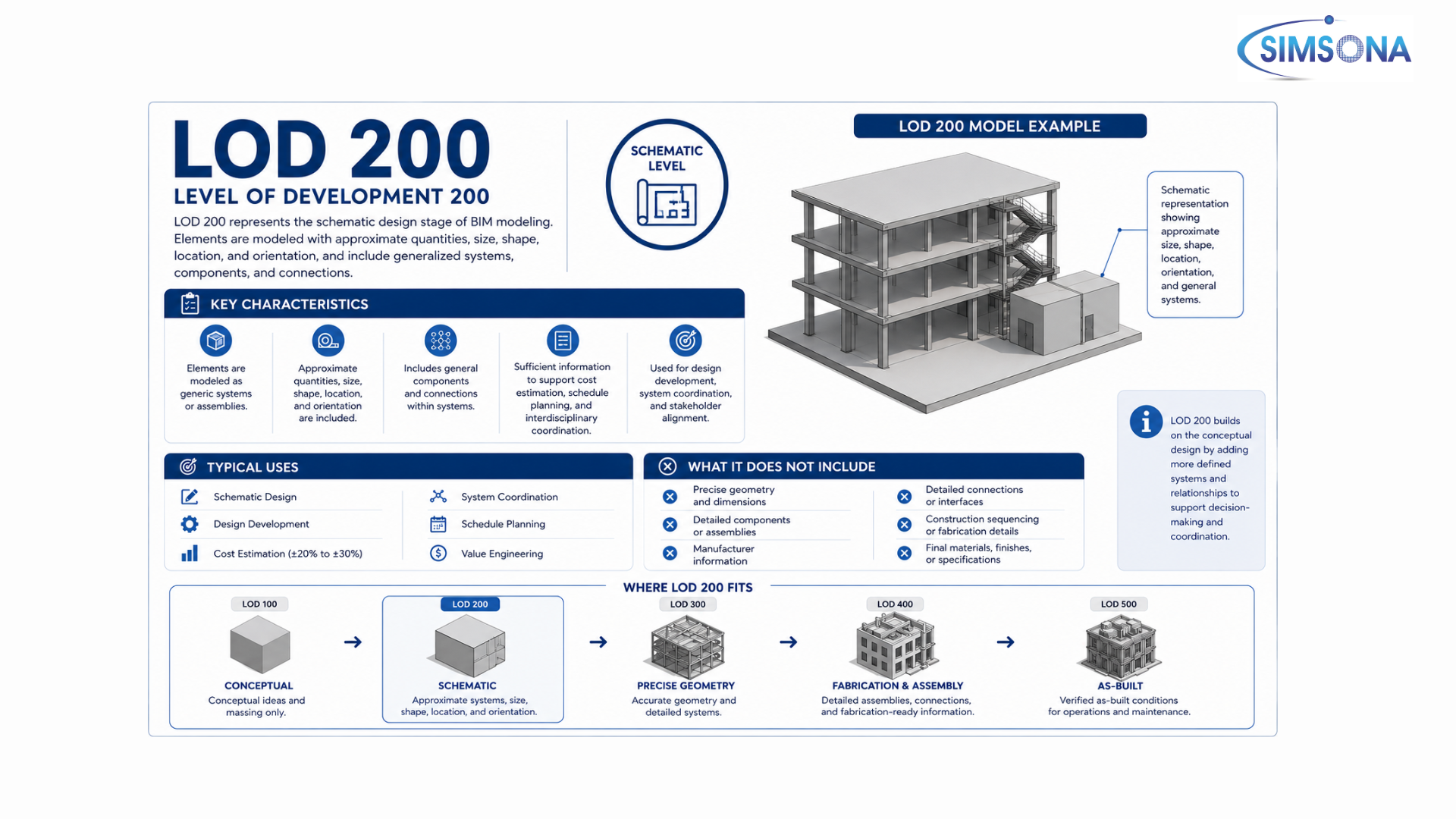
LOD 200, or Level of Development 200, is a preliminary BIM model stage that represents building elements with approximate geometry, size, location, and orientation, while including basic parametric and non-graphical data. Unlike LOD 100, which is purely conceptual with generic placeholders or massing, LOD 200 introduces more information for early design analysis, coordination, and decision-making.
At this level:
Building components such as walls, slabs, columns, beams, HVAC ducts, plumbing, and electrical systems are modeled with approximate dimensions but not fully detailed for construction.
Parametric attributes like material type, system category, preliminary load or flow data, and spatial relationships are embedded to support quantity take-offs, cost estimation, and early-stage design validation.
The model is suitable for schematic design, preliminary coordination, and feasibility studies, but not yet detailed enough for fabrication or construction documentation.
Key Features of LOD 200
Generalized Geometry: At the LOD 200 stage, building elements such as walls, slabs, beams, columns, ducts, pipes, and conduits are represented with approximate dimensions, orientation, and spatial location. While these components are not fully detailed for construction, the generalized geometry allows project stakeholders to visualize massing, volumetric context, and spatial relationships, providing a clear understanding of design intent during the early phases of the BIM workflow.
Embedded Non-Graphical Data (Parametric Attributes):
Beyond geometry, LOD 200 models incorporate basic parametric information for each element, including material type, system classification, load capacity, and flow specifications. For instance, a duct may include airflow rate and diameter, whereas a structural column might carry material grade and preliminary load data. This embedded information supports early quantity take-offs, cost estimation, and lifecycle planning, providing project teams with actionable insights without requiring construction-level precision.
Preliminary System Information Integration:
LOD 200 can include early-stage operational and performance data for MEP and structural systems, such as HVAC load calculations, electrical demand, plumbing flow rates, and structural stability parameters. This facilitates initial energy simulations, constructability studies, and system performance analysis, ensuring that design decisions are informed and practical from the outset.
Visual Representation: While not fully detailed, LOD 200 provides 3D visual context, helping teams and clients understand spatial relationships and design intent.
Advantages of LOD 200
Improved Early-Stage Design Visualization:
LOD 200 provides a three-dimensional representation of building components with approximate geometry and parametric data, enabling architects, engineers, and clients to visualize massing, spatial relationships, and system layouts early in the design process. This visualization fosters better understanding of design intent, allowing stakeholders to make informed decisions before the project progresses to more detailed stages like LOD 300.
Enhanced Coordination Across Disciplines:
By including generalized geometry and system information, LOD 200 facilitates early-stage coordination among architectural, structural, and MEP teams. Project teams can perform preliminary clash detection, identify spatial conflicts, and resolve potential issues before construction begins, significantly reducing the risk of rework and delays. This promotes interdisciplinary collaboration and integrated project delivery.
Time and Cost Efficiency:
LOD 200 enables preliminary quantity take-offs, cost estimation, and material planning due to its parametric attributes and approximate dimensions. Teams can generate early budget assessments and resource requirements, which helps in reducing cost overruns and avoiding late-stage design changes. Furthermore, early clash detection and design coordination save valuable time during both the design and construction phases.
Flexibility for Design Iterations:
Because LOD 200 elements are approximated and parametrically defined, the model supports rapid design modifications, alternative scenario evaluation, and iterative planning. Designers can easily adjust layouts, systems, and components in response to client feedback, site constraints, or regulatory requirements, promoting agile design workflows and efficient project optimization.
Limitations of LOD 200
Approximate Geometry and Dimensions:
One of the main limitations of LOD 200 is that all building components, including walls, beams, slabs, columns, and MEP systems, are represented with generalized and approximate geometry. While sufficient for visualization and early-stage coordination, this level of detail is not accurate enough for construction documentation, fabrication, or on-site installation, which requires precise measurements and specifications.
Limited Parametric and System Information:
Although LOD 200 includes basic non-graphical data such as material type, system classification, preliminary load capacity, or flow specifications, this information is not detailed enough for comprehensive engineering analysis, energy modeling, or structural validation. For accurate calculations and detailed system performance, the model must be upgraded to LOD 300 or higher.
Potential for Misinterpretation:
Because LOD 200 provides only approximate representations, there is a risk that stakeholders unfamiliar with BIM standards may assume the model is construction-accurate. This misinterpretation can lead to incorrect cost estimates, flawed spatial planning, or inadequate system coordination, emphasizing the need for clear documentation and communication of the model’s LOD level.
Limited Detection of Detailed Clashes:
While LOD 200 supports preliminary clash detection, it cannot identify all potential conflicts that occur at a detailed or fabrication level. Complex system clashes involving exact dimensions, connections, or tolerances may only be resolved in LOD 300 or LOD 350 models, limiting the model’s ability to fully prevent design errors.
LOD 200 is a critical stage in the BIM process, bridging conceptual ideas and detailed construction planning. By providing generalized geometry, parametric data, and system information, it allows project teams to visualize, coordinate, and analyze designs efficiently. While not suitable for construction-level detailing, its role in early-stage design, cost estimation, and interdisciplinary coordination makes it indispensable for modern BIM projects.
FAQ’S
1. What is LOD 200 in BIM?
LOD 200 represents the schematic design stage in Building Information Modeling, where elements are modeled with approximate geometry, size, shape, and location.
2. What level of detail is included in LOD 200?
At LOD 200, elements include generalized systems with approximate dimensions and quantities. Components such as walls, ducts, and pipes are represented but not fully defined or detailed.
3. What is the main purpose of LOD 200 models?
LOD 200 models are used for system layout, preliminary coordination, and early-stage cost estimation. They help teams understand how different building systems will interact.
4. Can clash detection be performed at LOD 200?
Yes, basic clash detection can be performed at LOD 200, but results may not be fully accurate due to approximate geometry and lack of precise detailing.
5. How does LOD 200 differ from LOD 100 and LOD 300?
Compared to LOD 100, LOD 200 introduces defined elements instead of conceptual masses. Compared to LOD 300, it lacks precise dimensions and finalized placement, making it less reliable for detailed coordination.

Send us
drawings and scope
Click the link below and send us your complete scope and drawings. We will provide quote/proposal in 24 to 48 hours.
 301-774-0880
