
Artificial intelligence (AI) for BIM: Simsona
Introduction
The Architecture, Engineering, and Construction (AEC) industry is undergoing a major digital transformation, and Artificial Intelligence (AI) is at the center of this evolution. Building Information Modeling (BIM), which has already revolutionized the way buildings and infrastructure projects are planned, designed, constructed, and managed, is now becoming even more powerful with the integration of AI technologies.
Traditionally, BIM has served as a centralized digital representation of physical and functional characteristics of a building. While BIM enables collaboration and data sharing among project stakeholders, many BIM workflows still depend heavily on manual effort, expert judgment, and repetitive tasks. Artificial Intelligence is changing this reality by automating processes, analyzing vast amounts of project data, identifying patterns, predicting outcomes, and supporting better decision-making throughout the project lifecycle.
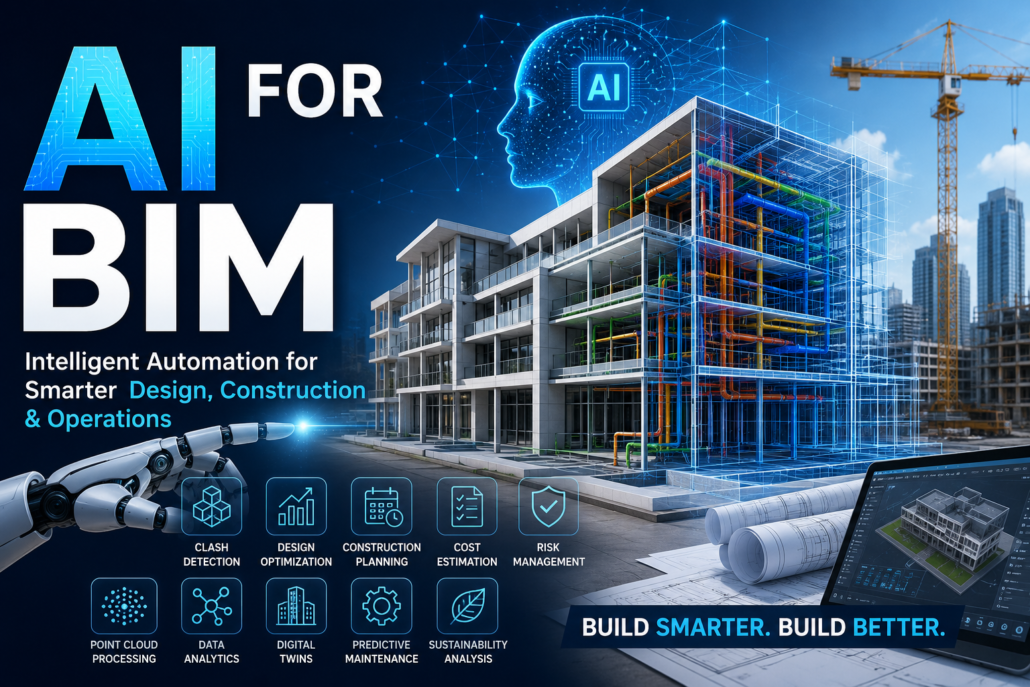
From automated clash detection and design optimization to predictive maintenance and digital twins, AI is helping project teams improve efficiency, reduce costs, enhance accuracy, and deliver projects faster than ever before. As AI technologies continue to mature, they are transforming BIM from a data management tool into an intelligent project delivery platform.
What is AI for BIM?
AI for BIM refers to the application of artificial intelligence technologies within Building Information Modeling workflows to automate tasks, improve decision-making, and extract actionable insights from project data.
AI systems can analyze large BIM datasets, identify patterns, learn from historical projects, and make recommendations that help architects, engineers, contractors, and facility managers perform their work more efficiently. Unlike traditional rule-based BIM processes, AI-enabled BIM systems can continuously learn and improve their performance over time.
The integration of AI into BIM creates a smarter project environment where models become more than static representations. They evolve into intelligent systems capable of supporting design validation, construction planning, resource optimization, risk assessment, and facility management.
Evolution of AI in BIM
The relationship between AI and BIM has evolved significantly over the past few decades.
In the early years, BIM software relied primarily on rule-based automation and predefined workflows. Designers manually created models, while coordination and conflict detection required significant human intervention.
As machine learning technologies emerged, BIM platforms began incorporating predictive capabilities. These systems could analyze historical project information to estimate costs, schedules, and potential risks.
The introduction of deep learning further expanded AI applications in BIM. Computer vision algorithms enabled automatic processing of construction site images, drone data, and laser-scanned point clouds.
Today, advanced AI technologies, including Generative AI and Agentic AI, are enabling autonomous workflows that can evaluate design alternatives, detect issues, coordinate multidisciplinary models, and continuously optimize project outcomes.
The future of BIM lies in intelligent systems capable of collaborating with human professionals while performing complex analytical tasks independently.
Key Technologies Driving AI-Powered BIM
Machine Learning
Machine Learning enables BIM systems to learn from historical project data and identify patterns that can improve future project performance.
Machine learning algorithms can analyze construction schedules, project budgets, resource allocation, and risk factors to provide accurate predictions and recommendations. By learning from completed projects, these systems become increasingly effective at forecasting outcomes and supporting decision-making.
Deep Learning
Deep Learning uses neural networks to process complex datasets such as images, videos, and point clouds.
In BIM applications, deep learning can identify construction defects, recognize building elements, classify objects within scanned environments, and support automated quality control processes.
Natural Language Processing (NLP)
Natural Language Processing allows AI systems to understand and interpret human language.
NLP can analyze project specifications, contracts, requests for information (RFIs), meeting minutes, and compliance documents. This capability helps project teams extract valuable information from large volumes of unstructured data.
Generative AI
Generative AI creates new design concepts and solutions based on project requirements and constraints.
Architects and engineers can use generative AI to rapidly explore multiple design alternatives, optimize space utilization, improve sustainability performance, and identify innovative solutions that may not be immediately apparent through traditional design approaches.
Agentic AI
Agentic AI represents the next stage of AI development in BIM. These intelligent agents can autonomously perform tasks, make decisions, and coordinate workflows across multiple systems.
Agentic AI can monitor project progress, identify conflicts, trigger corrective actions, communicate with stakeholders, and continuously optimize project performance with minimal human intervention.
Applications of AI in BIM
Intelligent Clash Detection
Clash detection is one of the most important BIM coordination activities. Traditional clash detection identifies geometric conflicts between building systems, but reviewing and resolving clashes often requires extensive manual effort.
AI-powered clash detection systems can prioritize critical clashes, eliminate false positives, recommend resolutions, and even automatically adjust model elements based on predefined project requirements.
This significantly reduces coordination time while improving overall model quality.
Automated Design Optimization
AI can evaluate thousands of design alternatives within minutes.
By considering factors such as structural performance, energy efficiency, daylight availability, construction costs, material usage, and occupant comfort, AI helps project teams identify optimal design solutions.
Design optimization enables better project outcomes while reducing the time required for iterative design processes.
Predictive Cost Estimation
Accurate cost estimation remains one of the biggest challenges in construction projects.
AI systems can analyze historical cost data, market trends, labor productivity, material prices, and project characteristics to generate more accurate estimates. These systems continuously refine their predictions as new project information becomes available.
Improved cost forecasting reduces financial uncertainty and supports better project planning.
Construction Scheduling and Planning
AI-powered scheduling tools can optimize construction sequences, resource allocation, and project timelines.
By analyzing historical schedules and current project conditions, AI identifies potential delays before they occur and recommends corrective actions. Project managers can use these insights to improve productivity and maintain project deadlines.
Risk Management
Construction projects face numerous risks related to safety, quality, costs, and schedules.
AI systems can identify risk indicators from BIM models, project documentation, sensor data, and historical records. Early risk detection enables proactive mitigation strategies that reduce project disruptions and financial losses.
Point Cloud Processing and Scan to BIM
Laser scanning technologies generate massive amounts of point cloud data that can be difficult to process manually.
AI automates object recognition, feature extraction, and model generation from point clouds. This accelerates Scan-to-BIM workflows while improving accuracy and reducing labor requirements.
Facility Management and Predictive Maintenance
The value of BIM extends far beyond construction completion.
AI-powered facility management systems use BIM data alongside sensor information from building systems to monitor asset performance, predict equipment failures, and optimize maintenance activities.
Predictive maintenance helps building owners reduce operational costs while extending asset lifespans.
AI and Digital Twins
Digital twins represent virtual replicas of physical assets that continuously update using real-time data.
When combined with AI, digital twins become powerful decision-support systems capable of monitoring building performance, predicting future conditions, optimizing operations, and simulating various scenarios.
AI-driven digital twins are increasingly being used in smart buildings, airports, hospitals, industrial facilities, and infrastructure projects.
Benefits of AI for BIM
The integration of AI into BIM provides numerous advantages:
- Faster project delivery through workflow automation.
- Improved model accuracy and consistency.
- Enhanced collaboration among project stakeholders.
- Reduced design and construction errors.
- Better cost control and budget forecasting.
- Optimized resource utilization.
- Increased construction productivity.
- Improved sustainability performance.
- Enhanced safety management.
- More effective facility operations.
These benefits contribute to higher project quality and improved return on investment.
Challenges of Implementing AI in BIM
Despite its potential, AI adoption in BIM presents several challenges.
Many organizations struggle with poor data quality, fragmented information systems, and limited AI expertise. AI models require large volumes of structured, reliable data to generate accurate results.
Integration with existing BIM software and workflows can also be complex. Additionally, concerns regarding data security, privacy, regulatory compliance, and workforce adaptation must be addressed.
Organizations that invest in training, data governance, and digital transformation strategies are better positioned to realize the full value of AI-enabled BIM.
Future of AI in BIM
The future of BIM will be increasingly intelligent, connected, and autonomous.
AI systems will become more capable of coordinating multidisciplinary teams, managing project information, optimizing designs, monitoring construction progress, and supporting facility operations in real time.
Emerging technologies such as Agentic AI, Generative Design, Digital Twins, Internet of Things (IoT), and advanced robotics will further expand BIM capabilities.
As these technologies mature, BIM will evolve from a modeling platform into a comprehensive intelligence platform that supports decision-making throughout the entire lifecycle of built assets.
Conclusion
Artificial Intelligence is redefining the future of Building Information Modeling by transforming how projects are designed, coordinated, constructed, and managed. Through intelligent automation, predictive analytics, and autonomous decision-making, AI enables BIM professionals to deliver projects more efficiently and accurately than ever before.
From clash detection and design optimization to digital twins and predictive maintenance, AI is creating new opportunities across the entire project lifecycle. Organizations that embrace AI-powered BIM today will be better equipped to meet the growing demands of modern construction while achieving higher levels of productivity, sustainability, and innovation.
The convergence of AI and BIM represents one of the most significant advancements in the AEC industry and will continue shaping the future of the built environment for years to come.
 301-774-0880