
How Bills of Materials (BOM) and Bills of Quantity (BOQ) Enhance BIM Services
Introduction
The construction industry has undergone a significant transformation with the adoption of Building Information Modeling (BIM). BIM has revolutionized the way architects, engineers, contractors, and project owners plan, design, construct, and manage buildings. One of the most valuable advantages of BIM is its ability to generate accurate project information directly from digital models. Among the most important outputs of BIM are the Bill of Materials (BOM) and the Bill of Quantity (BOQ). These documents play a crucial role in project planning, procurement, cost estimation, budgeting, and construction management.
By integrating BOM and BOQ with BIM services, project stakeholders gain access to reliable data that improves decision-making, reduces errors, minimizes waste, and enhances overall project efficiency. Understanding how BOM and BOQ contribute to BIM workflows is essential for maximizing the benefits of modern construction technology.
Understanding BOM and BOQ in BIM
Before exploring their role in BIM services, it is important to understand what BOM and BOQ represent.
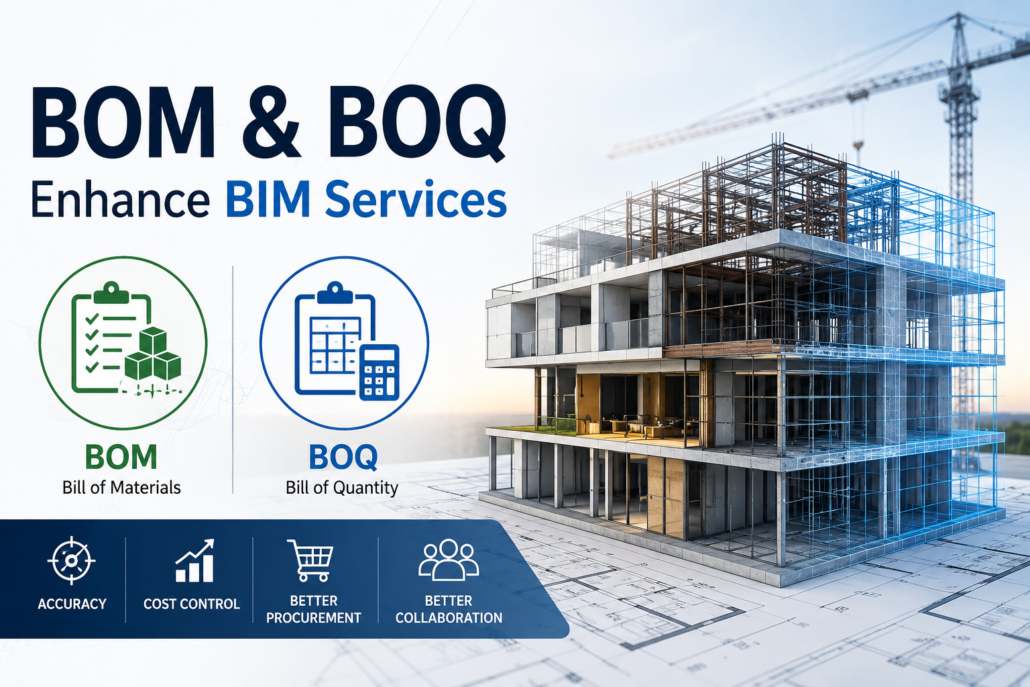
A Bill of Materials (BOM) is a comprehensive list of all materials, components, assemblies, and products required for a construction project. It provides detailed information about the materials needed to execute the project successfully.
A Bill of Quantity (BOQ), on the other hand, is a document that specifies the quantities of materials, labor, and work items involved in a construction project. It serves as a foundation for cost estimation, tendering, budgeting, and financial planning.
When BIM models are developed with accurate information and proper detailing, both BOM and BOQ can be generated automatically, eliminating many of the manual processes traditionally associated with quantity takeoffs and material calculations.
Improving Accuracy Through Automated Quantity Extraction
One of the biggest advantages of BIM-generated BOM and BOQ is the high level of accuracy they provide. Traditional quantity takeoff methods often involve manual calculations from two-dimensional drawings, which can lead to errors, omissions, and inconsistencies.
BIM models contain intelligent objects with embedded information about dimensions, materials, and specifications. As a result, quantity data can be extracted directly from the model. This automated process significantly reduces human error and ensures that material quantities accurately reflect the design.
Accurate quantity extraction allows project teams to develop reliable estimates, improve planning, and avoid costly mistakes during construction. As the model evolves, BOM and BOQ documents can be updated automatically, ensuring that stakeholders always have access to the latest project information.
Enhancing Material Procurement and Inventory Management
Material procurement is one of the most critical aspects of any construction project. Delays in material supply can disrupt project schedules and increase costs. BIM-generated BOMs provide project managers with a precise list of required materials, enabling better procurement planning.
With detailed material information readily available, procurement teams can identify what needs to be ordered, when it should be delivered, and how much is required at each stage of construction. This helps avoid material shortages, over-ordering, and unnecessary storage expenses.
In addition, BOM data supports effective inventory management by allowing project teams to monitor stock levels and track material usage throughout the project lifecycle. Better inventory control reduces waste and contributes to improved resource utilization.
Supporting Accurate Cost Estimation and Budget Planning
Cost estimation is a fundamental component of construction project management. Accurate budgeting requires precise information regarding quantities, materials, labor, and equipment.
BOQ generated through BIM provides a reliable basis for developing detailed project cost estimates. Since quantities are extracted directly from the digital model, estimators can produce more accurate budgets compared to traditional methods.
Project owners and developers benefit from improved financial forecasting because BIM-based BOQs offer greater transparency regarding project costs. The ability to monitor quantity changes in real time also helps stakeholders assess the financial impact of design modifications before construction begins.
As a result, BIM-enabled BOQ services reduce the risk of budget overruns and provide better control over project finances.
Facilitating Efficient Tendering and Contractor Bidding
The tendering process relies heavily on accurate quantity information. Contractors need reliable BOQ documents to prepare competitive and realistic bids.
BIM-generated BOQs provide contractors, suppliers, and subcontractors with detailed information about the scope of work and required quantities. This ensures that all bidders are working with the same project data, leading to more transparent and fair tendering processes.
Accurate quantity information reduces misunderstandings and minimizes disputes related to project scope. Contractors can submit bids with greater confidence, while project owners can evaluate proposals more effectively.
The result is a smoother procurement process and improved collaboration among project stakeholders.
Managing Design Changes More Effectively
Design changes are common during construction projects. In traditional workflows, any design modification often requires extensive recalculations of quantities and costs, which can be time-consuming and prone to errors.
BIM addresses this challenge by maintaining a centralized digital model that automatically updates associated project data whenever modifications occur. As changes are made to the model, BOM and BOQ documents are revised accordingly.
This dynamic relationship between the BIM model and project quantities enables project teams to evaluate the impact of design changes quickly. Decision-makers can assess cost implications, procurement requirements, and scheduling adjustments before approving modifications.
Consequently, BIM-supported BOM and BOQ services improve change management and reduce project risks.
Improving Project Scheduling and Construction Planning
Accurate quantity information plays a significant role in project scheduling and construction sequencing. BIM-generated BOQs help project managers understand the volume of work required for different construction activities.
By linking quantity data with project schedules, teams can develop more realistic timelines and allocate resources efficiently. Material deliveries, labor deployment, and equipment usage can be coordinated more effectively based on actual project requirements.
This level of planning reduces delays, improves productivity, and ensures smoother project execution.
Increasing Transparency and Collaboration
Construction projects involve multiple stakeholders, including architects, engineers, contractors, suppliers, consultants, and owners. Effective collaboration depends on access to accurate and up-to-date project information.
BOM and BOQ generated through BIM create a common source of truth for all project participants. Everyone works from the same data, reducing discrepancies and improving communication.
Suppliers can better understand material requirements, contractors can plan construction activities accurately, and owners can monitor project costs more effectively. This transparency fosters trust and encourages collaboration throughout the project lifecycle.
Reducing Waste and Promoting Sustainability
Sustainability has become a major priority in modern construction. BIM-generated BOM and BOQ services contribute to sustainable construction practices by improving material management and reducing waste.
Accurate quantity calculations prevent excessive material ordering and minimize unused inventory. Better planning reduces rework and material losses caused by estimation errors.
By optimizing resource utilization, BIM helps construction firms reduce their environmental impact while simultaneously lowering project costs.
Conclusion
Bills of Materials (BOM) and Bills of Quantity (BOQ) are essential components of modern BIM services. By leveraging the intelligent data contained within BIM models, construction professionals can generate highly accurate material lists and quantity reports that support every phase of a project.
From procurement and inventory management to cost estimation, tendering, scheduling, and change management, BOM and BOQ significantly enhance project efficiency and decision-making. They improve transparency, reduce waste, strengthen collaboration, and provide better control over project budgets and resources.
As BIM adoption continues to grow across the construction industry, the integration of BOM and BOQ will remain a critical factor in delivering successful, cost-effective, and sustainable construction projects.
 301-774-0880