
Architectural BIM Model Quality Control Process
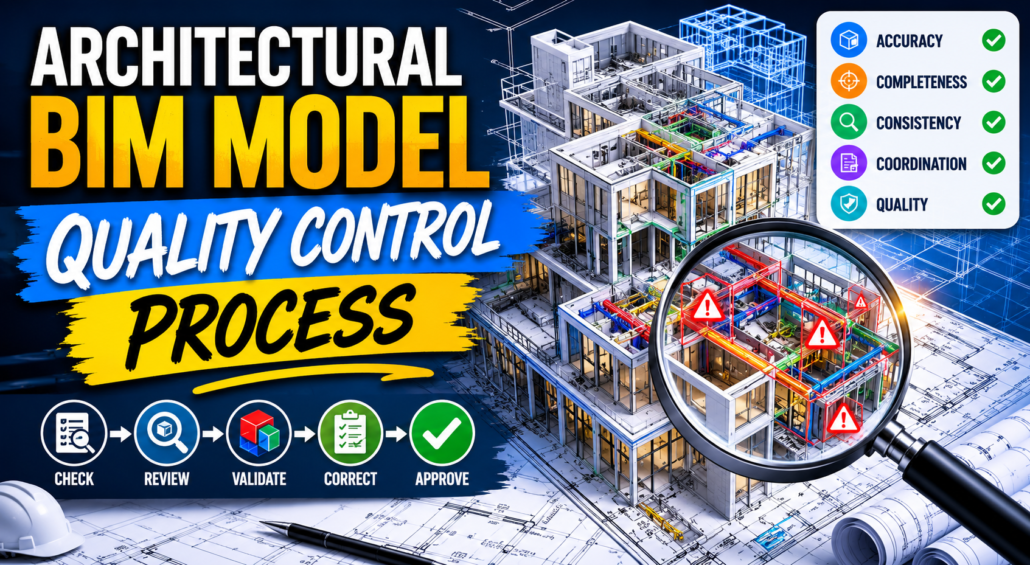
As Building Information Modeling (BIM) becomes increasingly central to architecture, engineering, and construction workflows, the accuracy and reliability of BIM models have become critical project concerns. A BIM model is more than a digital representation of a building—it is a shared source of information used for design development, coordination, quantity estimation, construction planning, and facility management.
However, the value of BIM depends heavily on model quality. Even highly detailed models can become ineffective if they contain inaccurate geometry, inconsistent data, missing information, or coordination errors. Poor-quality BIM models can lead to project delays, rework, budget overruns, and communication breakdowns among stakeholders.
This is where the Architectural BIM Model Quality Control (QC) Process becomes essential.
Quality control in BIM is a systematic process designed to verify that architectural models meet project requirements, industry standards, and coordination expectations before they are shared or used downstream. Rather than functioning as a final inspection activity, BIM quality control is an ongoing process integrated throughout the project lifecycle.
For architectural teams, a strong BIM QC process ensures that models remain reliable, coordinated, and construction-ready. As project complexity and collaboration demands continue to increase, model quality control has become a strategic necessity rather than an optional technical task.
Understanding BIM Quality Control in Architecture
Architectural BIM quality control refers to the procedures and standards used to evaluate and maintain the integrity of a BIM model.
The primary objective is to ensure that the model is:
- Geometrically accurate.
- Properly organized.
- Data-rich and consistent.
- Coordinated with project disciplines.
- Compliant with project standards.
- Suitable for its intended use.
It is important to distinguish quality control from quality assurance.
Quality Assurance (QA) focuses on establishing workflows, standards, and preventive measures that guide model creation.
Quality Control (QC) focuses on inspecting and verifying the model itself to identify and correct issues.
In practice, successful BIM delivery depends on both. While QA establishes the rules, QC verifies that those rules have been followed.
Architectural BIM quality control typically occurs at multiple project milestones, including schematic design, design development, construction documentation, and model handover.
Why BIM Model Quality Control Matters
Architectural models serve as foundational information sources for multiple project stakeholders.
Structural engineers, MEP consultants, contractors, cost estimators, and facility managers often rely on architectural BIM data to perform their own work. If architectural models contain errors or inconsistencies, those issues can spread across the project ecosystem.
The consequences of poor BIM quality may include:
- Coordination conflicts.
- Construction rework.
- Delayed approvals.
- Cost escalation.
- Inaccurate quantity takeoffs.
- Reduced stakeholder confidence.
Quality control helps prevent these problems by ensuring that models remain dependable and aligned with project objectives.
The financial impact is particularly significant.
Industry studies consistently show that correcting design issues during construction is far more expensive than identifying them during design development. BIM QC reduces this risk by detecting problems early, when revisions are faster and less costly.
Beyond risk reduction, quality-controlled BIM models also improve workflow efficiency and team productivity.
Establishing BIM Standards and Modeling Guidelines
The foundation of effective BIM quality control lies in clearly defined standards.
Without agreed-upon modeling rules, teams may develop inconsistent practices that create confusion and coordination problems.
Architectural firms typically establish QC standards through:
- BIM Execution Plans (BEP).
- Project modeling guidelines.
- Naming conventions.
- Level of Development (LOD) requirements.
- Company BIM standards.
- Client-specific protocols.
These standards create consistency across model development.
Typical architectural BIM standards address:
File Organization
Clear project structures and linked model management.
Naming Conventions
Consistent naming for views, sheets, families, and parameters.
Model Coordinates
Proper positioning and shared coordinate systems.
Template Standards
Predefined project settings and annotation systems.
LOD Requirements
Expected model detail at each project stage.
When standards are defined early and communicated effectively, quality control becomes more efficient and objective.
Instead of relying on subjective judgment, reviewers can evaluate models against established benchmarks.
Geometry and Model Accuracy Checks
One of the most fundamental aspects of BIM quality control involves verifying geometric accuracy.
Architectural geometry forms the basis for coordination, visualization, and construction documentation. Errors in model geometry can create major downstream problems.
QC teams typically review:
- Wall and floor alignment.
- Room boundaries.
- Door and window placement.
- Ceiling coordination.
- Vertical clearances.
- Level assignments.
- Building dimensions.
Even minor inaccuracies can affect multiple disciplines.
For example, improperly aligned walls may disrupt structural coordination or interfere with MEP routing.
Geometry reviews also focus on identifying modeling errors such as:
- Duplicate elements.
- Overlapping geometry.
- Unconnected components.
- Inaccurate constraints
- Misaligned objects.
Architectural teams often combine manual review with software-based checking tools to improve accuracy and reduce oversight.
Regular geometry verification helps ensure that models accurately represent design intent.
Data and Information Validation
BIM quality extends beyond visual accuracy.
A model may appear correct while containing incomplete or inconsistent data.
Because BIM models support scheduling, quantity extraction, and asset information management, embedded data must be carefully validated.
Architectural QC processes typically examine:
- Element parameters.
- Material assignments.
- Classification systems.
- Room data.
- Area calculations.
- Metadata consistency.
- Asset information requirements.
Missing or inaccurate data can compromise project decisions.
For example, incorrectly assigned wall types may affect material schedules and cost estimates.
Information validation becomes especially important for projects involving facility management or digital handover requirements.
Architectural teams increasingly rely on structured data standards to maintain consistency and ensure interoperability across project platforms.
A well-controlled BIM model combines both geometric and informational accuracy.
Model Coordination and Clash Detection
Architectural models rarely exist in isolation.
Modern building projects involve close coordination between architecture, structural systems, and MEP disciplines.
Quality control therefore includes coordination verification.
Clash detection is one of the most recognizable BIM QC activities.
By comparing architectural models against consultant models, teams can identify:
- Structural conflicts.
- Mechanical interference.
- Ceiling coordination issues.
- Service routing problems.
- Access and clearance concerns.
Early clash identification offers significant advantages.
Traditional coordination methods often discovered conflicts during construction, resulting in redesign and field modifications.
BIM-based coordination allows teams to resolve these issues digitally before construction begins.
Architectural teams frequently participate in coordination meetings where clashes are reviewed, prioritized, and assigned for resolution.
This process improves collaboration and strengthens model reliability.
Reviewing Documentation and Drawing Consistency
Architectural BIM models generate construction documentation, making drawing consistency an important QC priority.
Because BIM creates interconnected views, revisions typically update across plans, elevations, and sections automatically.
However, documentation issues can still occur.
Quality control reviews commonly evaluate:
- Sheet organization.
- Annotation accuracy.
- View consistency.
- Dimension alignment.
- Tag accuracy.
- Detail references.
- Graphic standards.
Documentation inconsistencies can confuse contractors and create approval delays.
For example, mismatched dimensions or incorrect annotations may result in requests for clarification or field interpretation.
QC teams therefore verify that drawings accurately reflect the underlying model and comply with project standards.
Maintaining documentation quality strengthens communication and reduces construction ambiguity.
Model Performance and File Health Checks
As architectural BIM models become larger and more detailed, performance management becomes an important aspect of quality control.
Poor-performing models can slow production, disrupt collaboration, and increase the likelihood of errors.
BIM QC includes monitoring overall model health.
Common file performance checks include:
- Excessive file size.
- Unused families.
- Corrupt elements.
- Overloaded views.
- Linked model management.
- Warning resolution.
- Model audit status.
A model burdened with unresolved warnings or unnecessary content may become unstable and difficult to manage.
Architectural teams often conduct periodic maintenance activities such as:
- Purging unused content
- Auditing files
- Cleaning imported CAD data
- Optimizing family usage
These measures improve responsiveness and maintain long-term project efficiency.
Model performance should be viewed as a quality issue, not merely a technical inconvenience.
The Role of Automated BIM Checking Tools
Technology has significantly strengthened BIM quality control capabilities.
While manual review remains important, automated checking tools provide speed, consistency, and repeatability.
Architectural teams commonly use BIM validation software to evaluate:
- Rule-based compliance
- Geometry conflicts
- Naming standards
- Data completeness
- Code compliance requirements
- Coordination issues
Automation reduces repetitive checking tasks and helps identify issues that may be overlooked during visual inspection.
However, software tools should complement—not replace—professional judgment.
Architecture involves design intent, constructability considerations, and contextual decision-making that often require human interpretation.
The most effective QC workflows combine automated validation with experienced design review.
This balanced approach improves reliability while preserving design understanding.
Challenges in BIM Quality Control
Despite its benefits, BIM quality control presents several challenges.
One common issue is inconsistency in modeling practices across teams and consultants.
Without strong standards and oversight, quality expectations may vary significantly.
Time pressure can also weaken QC efforts.
Project deadlines sometimes encourage teams to prioritize production speed over model verification, increasing the risk of errors.
Another challenge involves skill gaps.
Effective BIM QC requires technical expertise, software knowledge, and an understanding of design coordination principles.
Not all project teams possess the same level of capability.
Additionally, increasingly detailed models may create excessive checking requirements if QC procedures are not properly structured.
Organizations must therefore balance thorough verification with practical workflow efficiency.
The Future of Architectural BIM Quality Control
The future of BIM quality control is becoming increasingly intelligent and predictive.
Emerging technologies are reshaping how architectural teams evaluate model quality.
Several trends are influencing the field:
AI-Powered Model Review
Artificial intelligence can identify patterns, predict coordination risks, and automate rule checking.
Cloud-Based Collaboration
Real-time model sharing improves issue tracking and multidisciplinary review.
Digital Twin Integration
Operational building data may increasingly validate design assumptions and model accuracy.
Advanced Rule-Based Validation
Custom checking systems can align directly with project and client requirements.
These innovations are moving BIM QC beyond error detection toward proactive model optimization.
Instead of merely finding problems, future quality control systems may help prevent them entirely.
Conclusion
Architectural BIM Model Quality Control is a critical component of successful BIM delivery.
High-quality BIM models support accurate coordination, reliable documentation, informed decision-making, and efficient project execution. Without effective quality control, even sophisticated models can become sources of risk and confusion.
By establishing standards, validating geometry and data, coordinating across disciplines, and leveraging automated tools, architectural teams can maintain dependable and construction-ready models.
As BIM adoption continues to grow and project complexity increases, quality control will become even more central to architectural practice.
Ultimately, BIM quality control is not simply about correcting errors—it is about building confidence in the digital foundation upon which modern architecture depends.
 301-774-0880