
BIM Adoption Challenges for General Contractors and How to Fix Them
Introduction
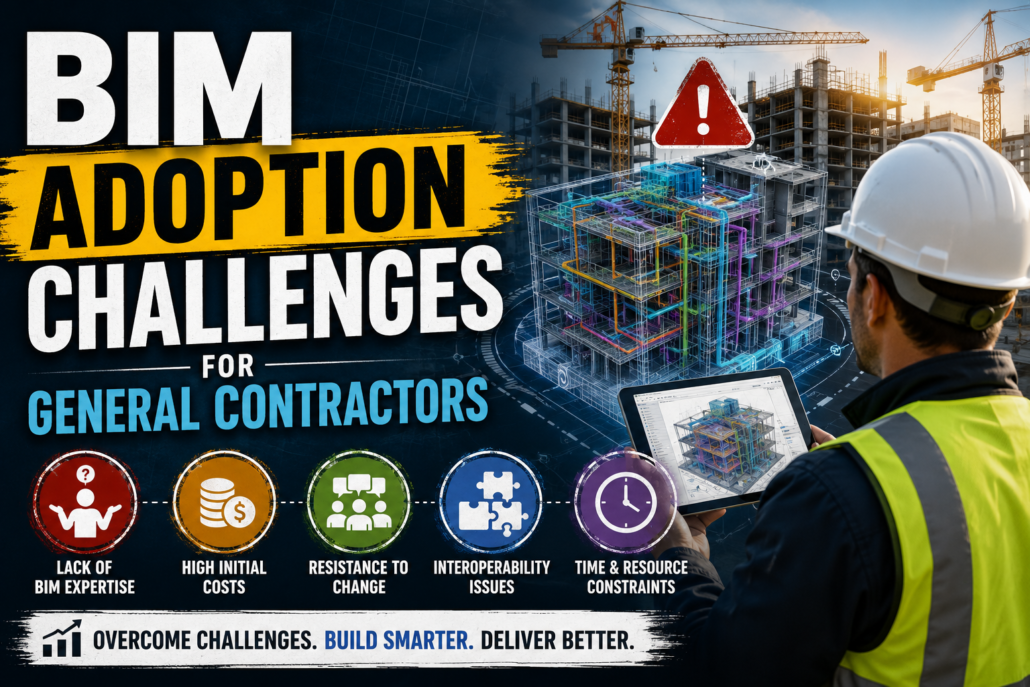
Building Information Modeling (BIM) has transformed the construction industry by improving collaboration, reducing errors, and enabling data-driven project management. While architects and engineers have embraced BIM for design and coordination, many general contractors (GCs) still face significant obstacles when integrating BIM into their day-to-day construction operations.
For general contractors, BIM is no longer just a 3D visualization tool—it has become a comprehensive project management platform that supports scheduling (4D), cost estimation (5D), quantity takeoffs, clash detection, site logistics, safety planning, and facility management. Owners across the United States increasingly require BIM deliverables for public infrastructure, healthcare facilities, educational institutions, airports, and commercial developments.
Despite its proven advantages, successful BIM implementation requires changes in technology, workflows, company culture, and workforce skills. Understanding these challenges—and knowing how to overcome them—is essential for contractors who want to remain competitive.
This article explores the most common BIM adoption challenges for general contractors and practical strategies to solve them.
Why BIM Matters for General Contractors
General contractors coordinate multiple stakeholders, including:
- Architects
- Structural engineers
- MEP consultants
- Specialty subcontractors
- Fabricators
- Suppliers
- Owners
- Facility managers
BIM acts as a centralized digital environment where every stakeholder can collaborate using accurate project information.
Benefits include:
- Reduced RFIs
- Better clash detection
- Improved construction sequencing
- Accurate quantity takeoffs
- Lower rework costs
- Better schedule management
- Enhanced communication
- Improved safety planning
- Digital project documentation
According to industry research, projects using mature BIM workflows often experience measurable reductions in coordination errors and construction delays compared with traditional 2D-based workflows.
Major BIM Adoption Challenges for General Contractors
1. High Initial Investment
One of the biggest concerns is the upfront cost.
Implementing BIM typically involves:
- Software licenses
- Powerful workstations
- Cloud collaboration platforms
- Employee training
- BIM consultants
- Process development
- Hardware upgrades
Small and medium-sized contractors often hesitate because the return on investment isn’t immediately visible.
How to Fix It
Rather than adopting everything at once:
- Start with pilot projects.
- Use subscription-based software.
- Prioritize high-impact workflows.
- Expand BIM capabilities gradually.
- Track measurable ROI from completed projects.
2. Resistance to Organizational Change
Many experienced construction professionals have spent decades using traditional workflows.
Common concerns include:
- “We’ve always done it this way.”
- Fear of new technology
- Concerns about job security
- Lack of confidence using software
Without leadership support, BIM adoption often fails.
How to Fix It
Successful companies:
- Build executive-level BIM commitment.
- Communicate benefits clearly.
- Involve project managers early.
- Celebrate small BIM successes.
- Develop BIM champions within each department.
Culture change is often more important than software implementation.
3. Lack of Skilled BIM Professionals
Finding experienced BIM coordinators and model managers remains difficult.
General contractors often struggle to hire professionals with experience in:
- Model coordination
- Navisworks clash detection
- Revit construction workflows
- Quantity extraction
- 4D simulation
- BIM execution planning
How to Fix It
Invest in:
- Internal training programs
- Certification courses
- Mentorship initiatives
- Partnerships with BIM consultants
- University recruitment programs
Upskilling existing employees is often more cost-effective than relying solely on new hires.
4. Poor Model Quality from Design Teams
General contractors frequently inherit models that were created primarily for design—not construction.
Problems include:
- Missing elements
- Incorrect object data
- Inconsistent naming
- Duplicate components
- Low Levels of Development (LOD)
- Poor coordination
These issues limit the model’s usefulness during construction.
How to Fix It
Establish clear BIM requirements before construction begins.
Create a comprehensive:
- BIM Execution Plan (BEP)
- Model review checklist
- LOD requirements
- Naming standards
- Data validation process
Early model audits can identify issues before they affect field operations.
5. Interoperability Problems
Construction teams often use multiple software platforms, including:
- Autodesk Revit
- Navisworks
- Tekla Structures
- Civil 3D
- Archicad
- Bentley applications
- Primavera P6
- Microsoft Project
Data exchange between platforms isn’t always seamless.
How to Fix It
Use open standards whenever possible:
- IFC
- BCF
- COBie
Adopt Open BIM workflows that improve collaboration between different software ecosystems.
6. Unclear BIM Standards
Without company-wide standards, every project team develops different modeling practices.
This leads to:
- Inconsistent file structures
- Naming confusion
- Version control issues
- Coordination delays
How to Fix It
Develop company BIM standards covering:
- File naming
- Model organization
- Shared coordinates
- Clash workflows
- Approval processes
- Data management
- Deliverables
Consistency improves efficiency across every project.
7. Difficulty Measuring ROI
Many contractors know BIM is beneficial but struggle to quantify its financial value.
Questions often include:
- Did BIM actually save money?
- How much rework was avoided?
- Were schedules shortened?
- Were RFIs reduced?
Without metrics, future investment becomes difficult to justify.
How to Fix It
Track KPIs such as:
- Number of clashes resolved before construction
- RFI reduction
- Change order reduction
- Schedule savings
- Rework costs
- Labor productivity
- Material waste reduction
Data-driven reporting demonstrates BIM’s business value.
8. Subcontractor BIM Readiness
Not all subcontractors possess BIM expertise.
Common issues include:
- Limited software access
- No BIM coordinators
- Lack of modeling standards
- Different workflows
This creates coordination gaps.
How to Fix It
General contractors should:
- Define BIM expectations during procurement.
- Include BIM requirements in contracts.
- Provide onboarding sessions.
- Conduct coordination meetings regularly.
- Offer model access through cloud platforms.
9. Large Model Performance Issues
Mega-projects often generate enormous BIM files.
Problems include:
- Slow loading
- Frequent crashes
- Long synchronization times
- Network delays
How to Fix It
Optimize models by:
- Dividing projects into worksets
- Removing unnecessary geometry
- Using linked models
- Purging unused content
- Employing cloud-based collaboration platforms
Regular model maintenance significantly improves performance.
10. Legal and Contractual Uncertainty
Questions often arise regarding:
- Model ownership
- Liability
- Intellectual property
- Design responsibility
- Data security
Without clear contractual language, disputes may occur.
How to Fix It
Contracts should define:
- BIM responsibilities
- Model ownership
- Data usage rights
- Model accuracy expectations
- Coordination responsibilities
- Deliverable requirements
Clear BIM execution plans reduce misunderstandings.
11. Cybersecurity and Data Management
Cloud-based collaboration introduces cybersecurity risks.
Threats include:
- Unauthorized access
- Data loss
- Ransomware attacks
- Version conflicts
How to Fix It
Implement:
- Multi-factor authentication
- Secure cloud platforms
- Role-based permissions
- Regular backups
- Audit logs
- Cybersecurity awareness training
Protecting project data is as important as creating it.
12. Integrating BIM with Field Operations
Many contractors stop using BIM once construction begins.
Field teams continue relying on printed drawings instead of digital models.
How to Fix It
Extend BIM to the jobsite through:
- Tablets
- Mobile BIM viewers
- QR code-linked models
- Laser scanning
- Reality capture
- Digital issue tracking
Connecting office and field teams maximizes BIM’s value.
Best Practices for Successful BIM Adoption
General contractors can improve implementation by following these best practices:
| Best Practice | Benefit |
|---|---|
| Start with pilot projects | Reduces implementation risk |
| Develop BIM standards | Ensures consistency |
| Invest in staff training | Improves adoption |
| Create a BIM Execution Plan | Defines workflows and responsibilities |
| Use cloud collaboration | Enables real-time coordination |
| Conduct regular clash detection | Prevents costly rework |
| Measure BIM KPIs | Demonstrates ROI |
| Involve subcontractors early | Improves project-wide collaboration |
| Standardize data management | Enhances information quality |
| Promote continuous improvement | Keeps workflows current |
The Future of BIM for General Contractors
BIM is evolving beyond model coordination. General contractors are increasingly integrating BIM with:
- Artificial Intelligence (AI) for predictive scheduling
- Digital Twins for real-time asset monitoring
- Internet of Things (IoT) sensors for construction tracking
- Reality Capture using drones and laser scanning
- Augmented Reality (AR) for on-site visualization
- Virtual Reality (VR) for safety training and client walkthroughs
- Robotics and automated construction equipment
- Sustainability analysis for carbon reduction and energy efficiency
These technologies are making BIM a central component of modern construction management rather than a standalone modeling tool.
Conclusion
BIM adoption presents undeniable challenges for general contractors, from high implementation costs and skills shortages to interoperability issues and organizational resistance. However, these barriers are manageable with a clear strategy, executive support, standardized workflows, ongoing training, and measurable performance metrics.
Rather than viewing BIM as another software investment, contractors should see it as a long-term business transformation that enhances collaboration, reduces risk, improves productivity, and delivers higher-quality projects. As owners and government agencies increasingly mandate BIM on construction projects, contractors that embrace digital construction today will be better positioned to win bids, streamline operations, and remain competitive in an evolving industry.
By addressing common adoption challenges proactively, general contractors can unlock BIM’s full potential and build a more efficient, resilient, and future-ready construction business.
 301-774-0880