
Challenges in Point Cloud Data Management
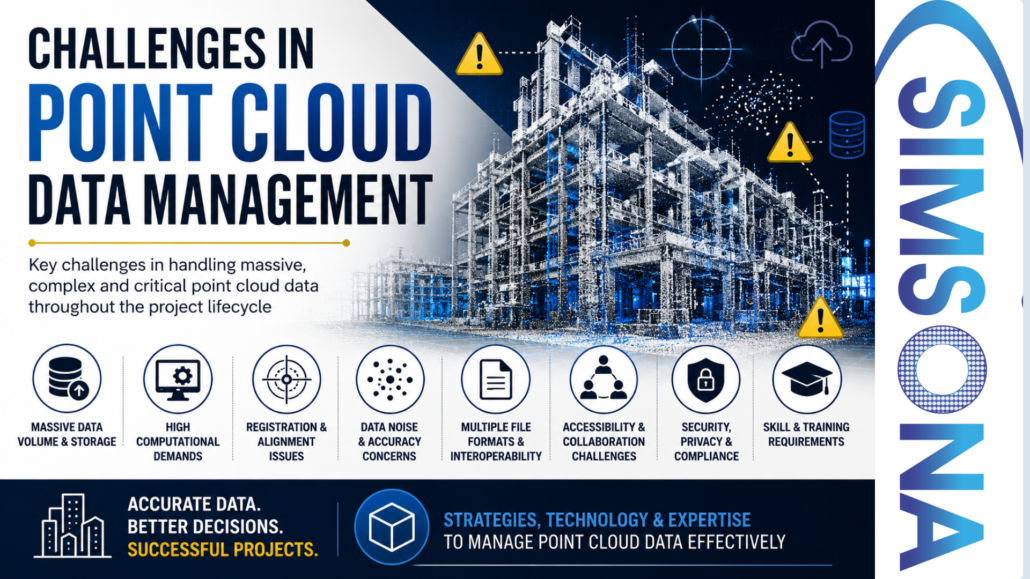
Point cloud technology has revolutionized the Architecture, Engineering, and Construction (AEC) industry by enabling accurate digital representation of existing structures and environments. Generated through laser scanning or photogrammetry, point cloud datasets contain millions or even billions of spatial data points that capture real-world conditions with remarkable precision. While these datasets are invaluable for Scan to BIM workflows, renovation projects, facility management, and infrastructure development, managing point cloud data presents several significant challenges. Organizations often struggle with storage, processing, integration, and quality control issues that can affect project efficiency and outcomes.
Massive Data Volume and Storage Requirements
One of the most significant challenges in point cloud data management is the enormous volume of data generated during scanning operations. A single building scan can produce several gigabytes of data, while large industrial facilities, airports, campuses, or infrastructure projects can generate terabytes of information. Storing such vast datasets requires robust server infrastructure, cloud storage solutions, and effective data management strategies.
As project sizes increase, organizations must invest in scalable storage systems capable of handling continuous data growth. Without proper storage planning, accessing and sharing point cloud files becomes difficult, leading to delays in project execution. Additionally, maintaining backups and ensuring data security further increase storage-related challenges.
High Computational Demands
Point cloud datasets require substantial computing power for visualization, processing, and analysis. Standard computers may struggle to load or manipulate large scans efficiently due to hardware limitations. Tasks such as point cloud registration, filtering, segmentation, and conversion into BIM models demand significant processing resources.
Engineering firms often need high-performance workstations equipped with powerful processors, advanced graphics cards, and large amounts of RAM. Even with advanced hardware, processing extremely dense datasets can be time-consuming. These computational requirements can increase project costs and limit accessibility for smaller organizations with constrained technology budgets.
Data Registration and Alignment Issues
Most projects require multiple scans from different locations to capture all aspects of a building or site. Combining these individual scans into a single coordinated dataset is known as registration. Accurate registration is critical because even minor alignment errors can result in inaccurate measurements and flawed BIM models.
Factors such as insufficient overlap between scans, poor target placement, environmental conditions, and human error can affect registration quality. Correcting misaligned scans often requires additional manual effort and expertise, increasing project timelines and costs. For complex facilities with numerous scanning positions, maintaining registration accuracy becomes even more challenging.
Data Noise and Accuracy Concerns
Point cloud datasets frequently contain unwanted information known as noise. Moving objects, reflective surfaces, weather conditions, vegetation movement, and scanner limitations can introduce inaccurate points into the dataset. These inaccuracies can complicate modeling efforts and reduce confidence in project deliverables.
Removing noise requires careful filtering and quality control processes. However, excessive filtering may accidentally eliminate important details, while insufficient filtering can leave errors in the dataset. Achieving the right balance between data cleanliness and data preservation remains a persistent challenge for scanning professionals.
Managing Multiple File Formats
Point cloud data can be generated and stored in numerous formats, including LAS, LAZ, E57, PTS, PTX, RCP, and RCS files. Different software platforms support different file types, creating interoperability challenges during project workflows.
When teams use various scanning equipment and BIM software solutions, converting files between formats can result in data loss, compatibility issues, or workflow inefficiencies. Maintaining consistency across software ecosystems requires careful planning and often specialized conversion tools.
Integration with BIM Platforms
Although Scan to BIM workflows have become increasingly sophisticated, integrating point cloud data into BIM software remains challenging. Large datasets can slow down BIM applications and negatively impact model performance. Designers and engineers must often simplify or segment point cloud files before importing them into BIM environments.
Additionally, converting raw point cloud information into intelligent BIM objects requires significant manual interpretation. While automation technologies continue to improve, identifying walls, columns, pipes, ducts, and structural elements accurately still requires human expertise in many cases. This creates bottlenecks in project workflows and increases modeling costs.
Data Accessibility and Collaboration Challenges
Modern construction projects involve multiple stakeholders, including architects, engineers, contractors, owners, and facility managers. Ensuring that all team members can access and work with point cloud data efficiently is often difficult.
Large file sizes can make data sharing slow and cumbersome, especially for distributed teams working remotely. Network limitations, software licensing requirements, and hardware compatibility issues can further restrict collaboration. Organizations must establish centralized data management systems and cloud-based platforms to improve accessibility while maintaining data security and version control.
Long-Term Data Maintenance
Point cloud data is increasingly being used for facility management and digital twin applications, requiring organizations to maintain datasets for years or even decades. Long-term storage introduces concerns related to file degradation, software obsolescence, and changing technology standards.
As scanning technologies evolve, older datasets may become incompatible with newer software platforms. Organizations must develop strategies for data migration, archival storage, and format standardization to ensure long-term usability and accessibility.
Security and Data Privacy Risks
Point cloud scans often capture sensitive information about buildings, industrial facilities, infrastructure assets, and restricted areas. Unauthorized access to this data can pose security risks and potentially expose confidential information.
Organizations must implement strong cybersecurity measures, including encryption, access controls, secure cloud environments, and data governance policies. Compliance with industry regulations and client requirements adds another layer of complexity to point cloud data management.
Skill and Training Requirements
Effective point cloud management requires specialized expertise in laser scanning technologies, data processing software, BIM workflows, and quality assurance procedures. Many organizations face skill shortages when implementing advanced scanning and modeling projects.
Training personnel to handle large datasets, perform accurate registrations, optimize workflows, and maintain data quality requires significant investment. Without experienced professionals, organizations may struggle to fully realize the benefits of point cloud technology.
Conclusion
Point cloud data management is a critical component of successful Scan to BIM and digital construction workflows. While point cloud technology provides unmatched accuracy and detailed spatial information, challenges related to storage, processing, registration, interoperability, collaboration, security, and long-term maintenance can significantly impact project efficiency. By implementing robust data management strategies, investing in appropriate technology infrastructure, adopting standardized workflows, and developing skilled teams, organizations can overcome these challenges and maximize the value of their point cloud datasets throughout the project lifecycle.



 301-774-0880