
MEP in Warehouses || Simsona
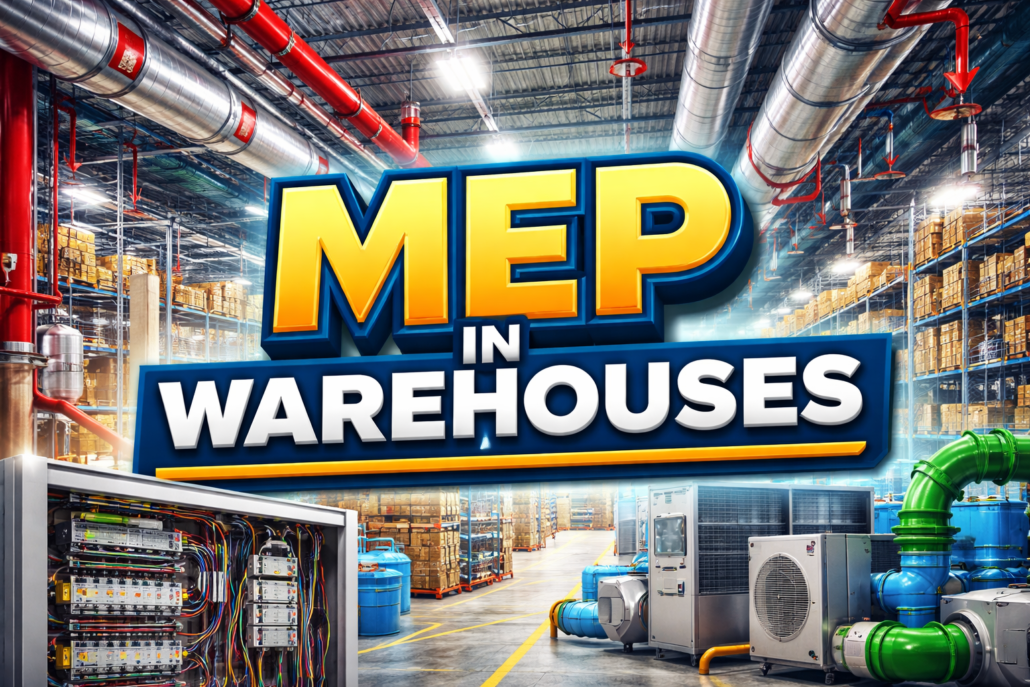
MEP in Warehouses
Warehouses are no longer just storage spaces filled with racks and goods. In today’s logistics-driven economy, they function as highly dynamic hubs that support inventory management, automation, distribution, and even e-commerce fulfillment. Whether it is a large-scale distribution center or a smaller regional storage facility, the efficiency of a warehouse depends heavily on its MEP, which stands for mechanical, electrical, and plumbing systems.
MEP systems form the operational backbone of warehouses. They ensure proper environmental conditions, reliable power supply for machinery, and efficient water management. A well-designed MEP system directly impacts productivity, safety, and operational costs, making it a critical component in warehouse planning and design.
Understanding MEP Systems in Warehouses
MEP systems in warehouses are designed differently from residential or commercial buildings because of the unique operational requirements. Warehouses often have large open spaces, high ceilings, heavy equipment, and continuous movement of goods and personnel.
Mechanical systems manage ventilation, temperature control, and air quality. Electrical systems power everything from lighting and conveyor belts to automated storage systems. Plumbing systems handle water supply, drainage, and fire protection.
Unlike office buildings, where occupant comfort is the primary concern, warehouse MEP design focuses on operational efficiency, safety, and adaptability.
Mechanical Systems in Warehouses
Mechanical systems in warehouses are primarily concerned with maintaining suitable environmental conditions for both goods and workers.
Ventilation and Airflow
Warehouses often store goods that may be sensitive to temperature or humidity. Proper ventilation ensures that air circulates efficiently, preventing heat buildup and maintaining air quality. In large facilities, natural ventilation is sometimes combined with mechanical ventilation systems to improve efficiency.
For warehouses dealing with chemicals, food products, or pharmaceuticals, specialized ventilation systems are required to maintain strict environmental standards. These systems may include exhaust fans, air filtration units, and humidity control mechanisms.
Temperature Control
Not all warehouses require full air conditioning, but temperature control is still important. For example:
- Cold storage warehouses require refrigeration systems to maintain low temperatures.
- E-commerce warehouses may use spot cooling for worker comfort.
- Climate-controlled storage facilities require consistent temperature and humidity levels.
Designing these systems requires careful calculation of heat loads, insulation, and energy usage.
Smoke Control and Safety Ventilation
In case of fire, warehouses must have systems that control smoke movement. Smoke ventilation systems help maintain visibility and allow safe evacuation. These systems are often integrated with fire detection and alarm systems.
Electrical Systems in Warehouses
Electrical systems are the most critical component in modern warehouses, especially with the rise of automation.
Power Distribution
Warehouses require a robust power distribution system to support the following:
- Conveyor belts.
- Automated storage and retrieval systems.
- Forklift charging stations.
- Packaging and sorting equipment.
Load calculations must consider peak demand to avoid overloading and ensure smooth operations.
Lighting Systems
Lighting design in warehouses is critical due to high ceilings and large floor areas. Poor lighting can lead to safety risks and reduced efficiency.
Modern warehouses use:
- High-efficiency LED fixtures.
- High bay lighting for tall storage racks.
- Motion sensors to reduce energy consumption.
Proper lighting placement ensures visibility in aisles and loading docks, improving both safety and productivity.
Backup Power and Reliability
Downtime in a warehouse can lead to significant financial losses. Therefore, backup systems such as generators and battery storage are essential. These systems ensure continuity during power outages, especially in facilities handling time-sensitive goods.
Automation and Smart Systems
With the growth of smart warehouses, electrical systems must support advanced technologies such as
- Robotics and automation systems.
- Warehouse management systems (WMS).
- Internet of Things devices for tracking and monitoring.
This technology requires a flexible and scalable electrical infrastructure.
Plumbing Systems in Warehouses
Although plumbing may seem less critical in warehouses compared to other buildings, it still plays an essential role in operations and safety.
Water Supply and Drainage
Warehouses require water for:
- Sanitation facilities for workers.
- Cleaning and maintenance.
- Certain industrial processes.
Efficient drainage systems are necessary to prevent water accumulation, especially in loading areas and during heavy rainfall.
Fire Protection Systems
Fire safety is one of the most important aspects of warehouse design. Plumbing systems are closely linked to fire protection infrastructure, including the following:
- Sprinkler systems.
- Fire hydrants.
- Water storage tanks.
Warehouses often store large quantities of goods, which can increase fire risk. Therefore, fire protection systems must be designed according to strict safety standards.
Specialized Systems
Some warehouses require additional plumbing systems, such as:
- Chemical storage facilities needing spill containment systems.
- Food storage warehouses requiring hygiene-focused water systems.
- Cold storage facilities needing defrost drainage systems.
Role of Building Information Modeling in Warehouse MEP Design
Modern warehouse projects rely heavily on building information modeling to design and coordinate MEP systems.
BIM allows engineers to create detailed three-dimensional models of the warehouse, integrating mechanical, electrical, and plumbing systems into a single platform. This helps in identifying potential conflicts between systems before construction begins.
For example, it ensures that ducts, pipes, and cable trays do not interfere with structural elements or storage systems. This level of coordination reduces errors, saves time, and minimizes construction costs.
BIM also supports future expansion by providing accurate digital records of the building systems, making it easier to upgrade or modify the facility.
Challenges in Warehouse MEP Design
Designing MEP systems for warehouses comes with several unique challenges.
One major challenge is the scale of the facility. Large warehouses require extensive distribution networks for power, air, and water. Ensuring uniform performance across such large areas can be complex.
Another challenge is flexibility. Warehouses often change their layout or operations based on business needs. MEP systems must be adaptable to accommodate these changes without major redesign.
Energy consumption is also a concern, especially in facilities with refrigeration or heavy automation. Designers must find ways to optimize energy use while maintaining performance.
Finally, coordination between different systems and teams is critical. Any design error can lead to operational inefficiencies or costly delays.
Sustainable MEP Practices in Warehouses
Sustainability is becoming increasingly important in warehouse design, especially with the growth of large logistics networks.
Many warehouses are adopting energy-efficient systems such as LED lighting and high-efficiency HVAC units. Solar panels are also commonly installed on large warehouse roofs to generate renewable energy.
Water conservation measures, such as rainwater harvesting and efficient drainage systems, are also being implemented.
In addition, smart building technologies allow real-time monitoring of energy and resource usage, helping operators optimize performance and reduce costs.
Future Trends in Warehouse MEP Systems
The future of warehouse MEP design is closely tied to automation and digital transformation.
Smart warehouses are becoming more common, with systems that can monitor and control lighting, temperature, and equipment in real time. Artificial intelligence is being used to predict maintenance needs and improve efficiency.
Electrification is another growing trend, particularly with the use of electric forklifts and charging infrastructure. This requires advanced electrical planning and load management.
Prefabricated MEP systems are also gaining popularity, as they reduce construction time and improve installation quality.
Conclusion
MEP systems are the backbone of modern warehouses, supporting everything from basic operations to advanced automation. A well-designed MEP system ensures that the facility operates efficiently, safely, and sustainably.
As warehouses continue to evolve into high-tech logistics hubs, the importance of integrated and flexible MEP systems will only increase. By leveraging advanced design tools like BIM and adopting sustainable practices, warehouse operators can create facilities that are not only efficient but also future-ready.
 301-774-0880